Every year, I speak with museum directors and finance heads across India who face the same challenge. They know their institution needs museum ticketing software. They see the inefficiencies. But when it is time to present the cost to a board of trustees or a government funding body, they have no clear framework to prove the investment will pay for itself.
Let me give you that framework. A practical, number-driven method to calculate ROI before you commit to any museum management software purchase.
Why Trustees and Government Bodies Demand ROI Before Approval
Museum leadership operates under financial scrutiny. Trustees want a clear link between software spend and measurable outcomes. Government bodies that fund public museums through the Ministry of Culture or state departments expect documented justification for any new technology expense.
The American Alliance of Museums found that museums at the lowest investment levels spend only 1 to 2 percent of their budgets on technology. These institutions rely on outdated systems, free tools, and minimal IT support. The result is missed revenue.
An ROI calculation converts abstract software benefits into concrete financial projections a finance committee can evaluate.
The ROI Formula Every Museum Finance Head Should Use
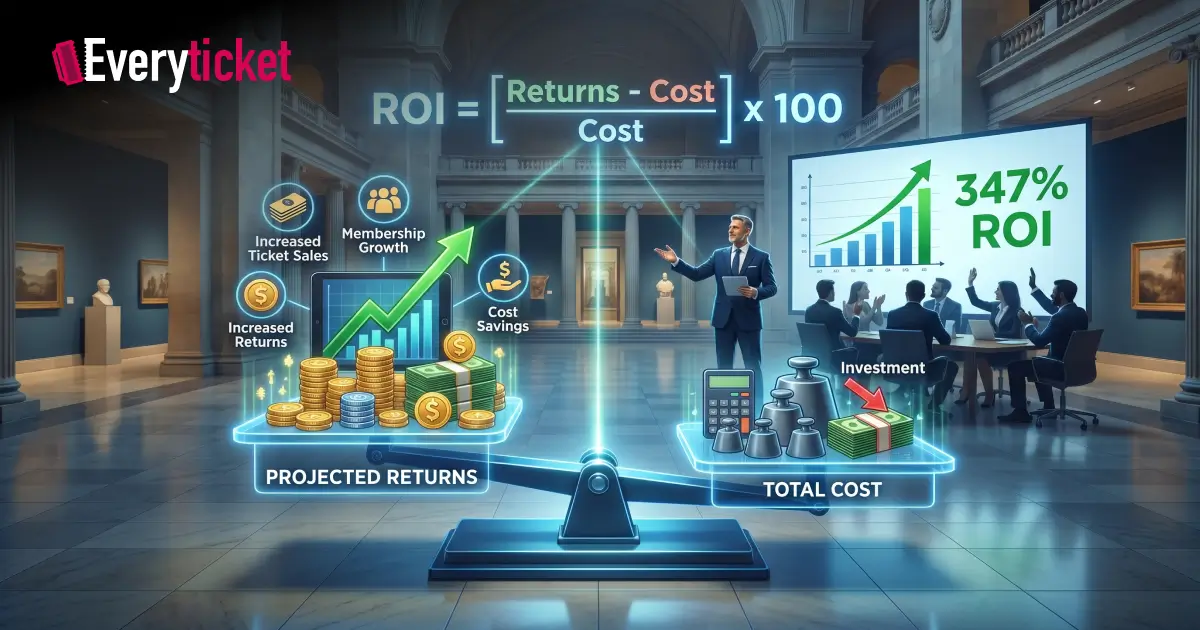
ROI (%) = [(Total Returns – Total Cost) / Total Cost] x 100
The challenge is accurately identifying what goes into “Total Returns” and “Total Cost.” I break both down below.
What Goes into the Cost Side of the Equation
Direct Costs
- Subscription or licence fees: Monthly or annual charges. Flat pricing models keep this predictable. Per-ticket commission models increase cost as visitor volume grows.
- Setup and onboarding fees: Some vendors charge separately for initial configuration. Others include setup at no extra cost.
- Hardware (if needed): Tablets for POS counters, QR scanners, or self-service kiosks.
Indirect Costs
- Staff training time: Hours your team spends learning the new museum management software. Calculate as hourly wages multiplied by training hours.
- Integration effort: Connecting ticketing software with your CRM, payment gateways, or accounting tools. Systems with built-in API integration reduce this cost.
- Transition downtime: Any period where operations slow during migration.
Hidden Costs to Watch For
- Per-transaction fees that compound with volume
- Charges for additional payment gateway integrations
- Costs for GST or tax compliance modules that are not included by default
- Vendor lock-in penalties if you switch later
How to Quantify the Returns Before You Buy
Returns from digital ticketing for museums fall into two categories: revenue gains and cost savings. Any credible museum management software should deliver both.
Revenue Gains You Can Project
Increased online ticket sales. Museums that move from manual or fragmented booking to unified digital ticketing for museums see measurable sales growth. From our work with institutions like MAP Bengaluru, ticket sales increased by 40% after implementing a modern ticketing platform. According to AAM’s research on digital evolution, the ROI for digital programs that charge admission is often exponentially better than for physical-only ones.
Higher per-visitor spend. When your system supports upsells at checkout (audio guides, tours, membership offers), average revenue per visitor increases. A well-configured admissions software turns every transaction into a revenue opportunity.
Membership conversions. Museums using CRM-integrated ticketing have reported up to 35% growth in membership sign-ups within six months.
Dynamic pricing. Adjusting ticket prices based on demand or day of week adds revenue without increasing visitor volume.
Cost Savings You Can Measure
- Reduced counter staffing. Digital ticketing for museums with QR-based entry cuts front-desk workload by up to 35% during peak hours.
- Eliminated printing costs. Paper tickets, receipt rolls, and manual logbooks are no longer needed.
- Lower reconciliation time. A unified museum ticketing system with POS syncs all transactions in real time, replacing manual cash tallying.
- Fewer booking errors. Double bookings and manual data entry mistakes carry a financial cost that disappears with automation.
A Sample ROI Calculation for a Mid-Sized Museum
Here is a realistic scenario for a museum with 1,00,000 annual visitors and an average ticket price of ₹100.
| Line Item | Annual Value (₹) |
| Current annual ticket revenue | ₹1,00,00,000 |
| Projected revenue increase (25%) | ~₹25,00,000 |
| Membership revenue gain | ~₹4,00,000 |
| Upsell revenue (audio guides, immersive experience) | ~₹3,00,000 |
| Staff cost savings (2 fewer counters) | ~₹4,80,000 |
| Printing and paper savings (go paperless) | ₹1,20,000 |
| Total Projected Returns | ₹38,00,000 |
| Annual infra cost | ~₹6,00,000 |
| Hardware and setup (one-time, amortised) | ~₹2,00,000 |
| Training time cost | ₹50,000 |
| Total Cost | ~₹8,50,000 |
| ROI | 347% |
These numbers are conservative. I have seen similar results across institutions in South India and Rajasthan after they adopted museum management software tailored to their workflows.
Red Flags That Will Destroy Your ROI
Not every museum ticketing software delivers equal value. Watch for these warning signs:
- Per-ticket commission pricing. A museum selling 1,00,000 tickets at ₹5 commission per ticket loses ₹5,00,000 annually to fees alone.
- No Indian payment support. If the platform does not support UPI, Rupay, and GST compliance natively, you will spend extra on workarounds.
- Fragmented systems. If online booking, POS, and reporting run on separate tools, you lose the operational efficiency that drives cost savings.
- Long implementation timelines. Every month of delayed go-live is a month of missed returns.
How to Present This to Your Board: A Trustee-Ready Framework
When I help museum directors prepare for board presentations, I recommend a one-page ROI summary with four sections:
- Current state costs. Document what you spend today on manual ticketing, staffing, printing, and lost revenue from booking friction.
- Projected returns. Use the formula and line items from this article with your museum’s actual numbers.
- Payback period. Most museums recover their investment in 3 to 6 months. State this clearly.
- Risk if no action is taken. Quantify the revenue you continue to lose each quarter by staying on legacy systems.
This format works for private trustees and government funding authorities alike.
Why Museums Across India Are Choosing EveryTicket for Measurable ROI
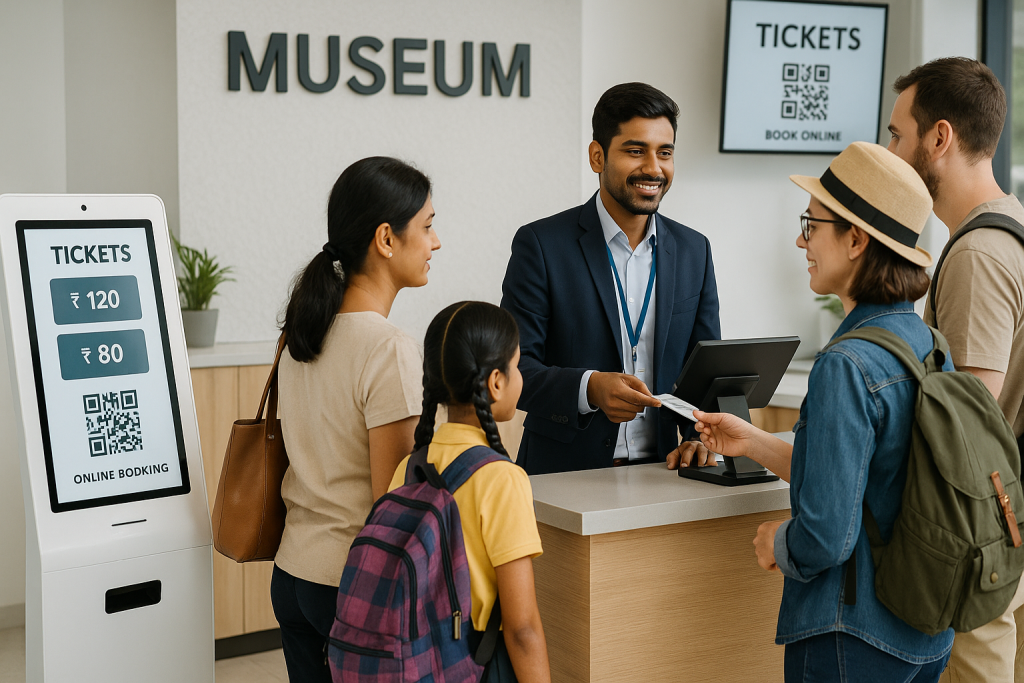
At EveryTicket, we built our museum ticketing software specifically for Indian museums. We have processed over 1,50,000 tickets, support 54,000+ online bookings at MAP Bengaluru alone, and museums go live on our platform within 60 minutes.
Our flat pricing means your ROI calculation stays predictable. No per-ticket commissions. No hidden charges. GST compliance, UPI payments, CRM, POS, and real-time analytics are included from day one.
If you are preparing an ROI case for your board, we offer a free ROI consultation and live demo. Book a demo call with our team to build a board-ready business case using your museum’s actual data.
Conclusion
Calculating ROI before purchasing digital ticketing for museums is a discipline. The formula is simple. The inputs are measurable. The output gives you a document that any trustee, finance committee, or government body can evaluate with confidence.
I have watched museums grow revenue within months of making this switch. The institutions that succeed are the ones that enter the decision with clear numbers.
FAQs
What is a good ROI for museum ticketing software?
Museums typically see 3x to 5x returns within 12 months through increased ticket revenue and reduced operational costs.
How much does museum ticketing software cost in India?
Costs range from ₹5,000 to ₹50,000 per month depending on features, visitor scale, and whether pricing is flat or per-ticket.
Can museum software justify its cost to government funding bodies?
Yes. ROI reports showing revenue growth, cost savings, and visitor data improvements are accepted by most government funding authorities.
What costs should museums include when calculating ticketing software ROI?
Include subscription fees, hardware, setup, staff training time, integration work, and any per-transaction or hidden charges.
How long does it take for museum ticketing software to show ROI?
Most museums begin seeing measurable returns within three to six months of implementing a digital ticketing system.