India’s cultural institutions are under mounting pressure to modernize. The country has over 1,000 museums, managed by central government bodies, state authorities, and private trusts. The global museum ticketing platform market was valued at $1.7 billion in 2024 and is projected to reach $4.5 billion by 2033. Asia Pacific is the fastest-growing region, driven by government investment and rising cultural tourism.
For museum groups managing multiple properties, the ticketing platform determines how visitors experience the brand, how visitor data is owned, and how revenue is tracked across locations. A white-label ticketing platform gives institutions full control over all of these areas. A generic event ticket sales platform does not.
Generic Ticketing Platforms Were Built for Concerts, Not Cultural Institutions
Most general-purpose event ticket sales platforms are designed for concerts, festivals, and one-time gatherings. Museums operate on an entirely different model:
- Timed entry slots that rotate across multiple daily sessions
- School group and tour operator booking workflows
- Membership programs tied directly to admissions
- GST-compliant billing and UPI payment requirements
- Multi-location reporting and capacity management
When a museum group uses a general event ticket sales platform, it forces museum-specific workflows into a tool not designed for them. Staff work around limitations. Visitors encounter checkout flows built for concerts. Revenue tracking becomes fragmented across locations.
Your Ticketing Page Is Promoting Another Brand to Your Visitors
A generic platform does not hide its identity. When visitors book tickets, the platform’s brand remains visible throughout the process:
- Visitors associate the booking experience with the platform, not the museum
- The platform recommends competing events to the visitors you worked to attract
- First-party visitor data is captured by the platform, not the institution
- Confirmation emails carry the platform’s name rather than the museum’s
A white-label ticketing platform removes all of this. Every page, email, and confirmation reflects the museum’s own brand. Visitor data stays with the institution and feeds into its CRM.
For museum chains managing multiple sites, brand consistency across locations is impossible on a generic event ticket sales platform. Each site ends up appearing as an unrelated entity to the visitor.
What a White Label Ticketing Platform Actually Puts in Your Hands
A white-label ticketing platform runs on proven backend technology but is delivered entirely under the institution’s own identity. In practice, this covers three areas:
Custom Domain and Visual Identity
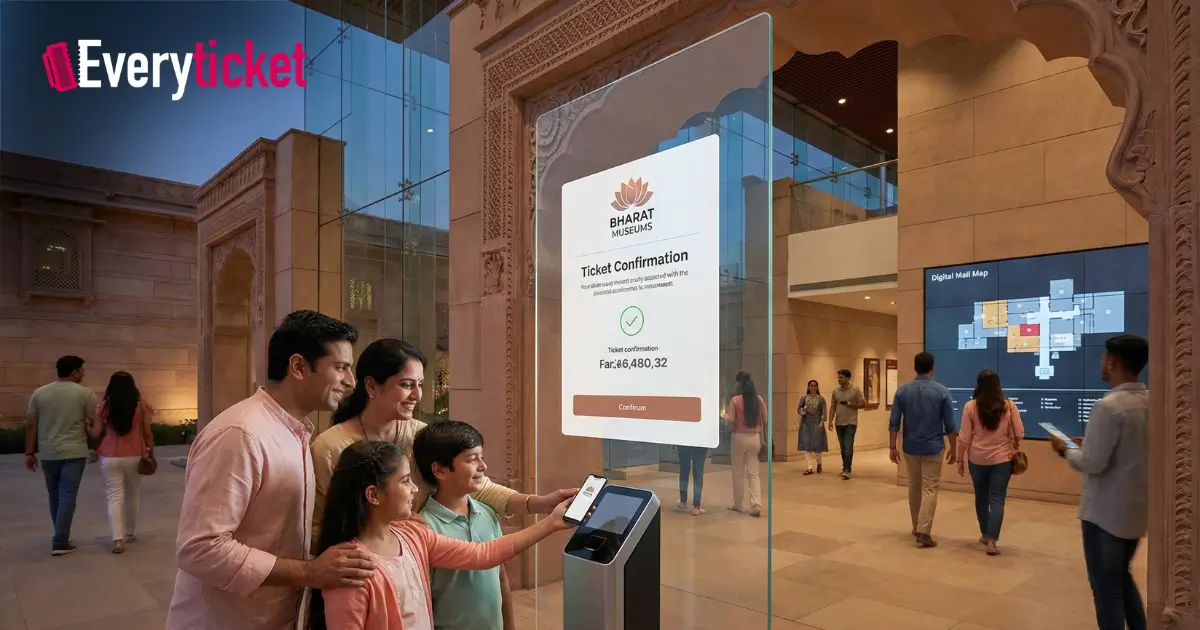
Booking pages run on the museum’s URL. Logos, colors, and fonts match the institution’s brand. Ticket designs and confirmation emails carry the museum’s identity throughout the visitor journey.
Visitor Data Ownership
All purchase and visitor records belong to the institution. Data feeds into the museum’s CRM. No third-party platform retains your visitor information or markets to your audience.
Museum-Specific Operational Tools
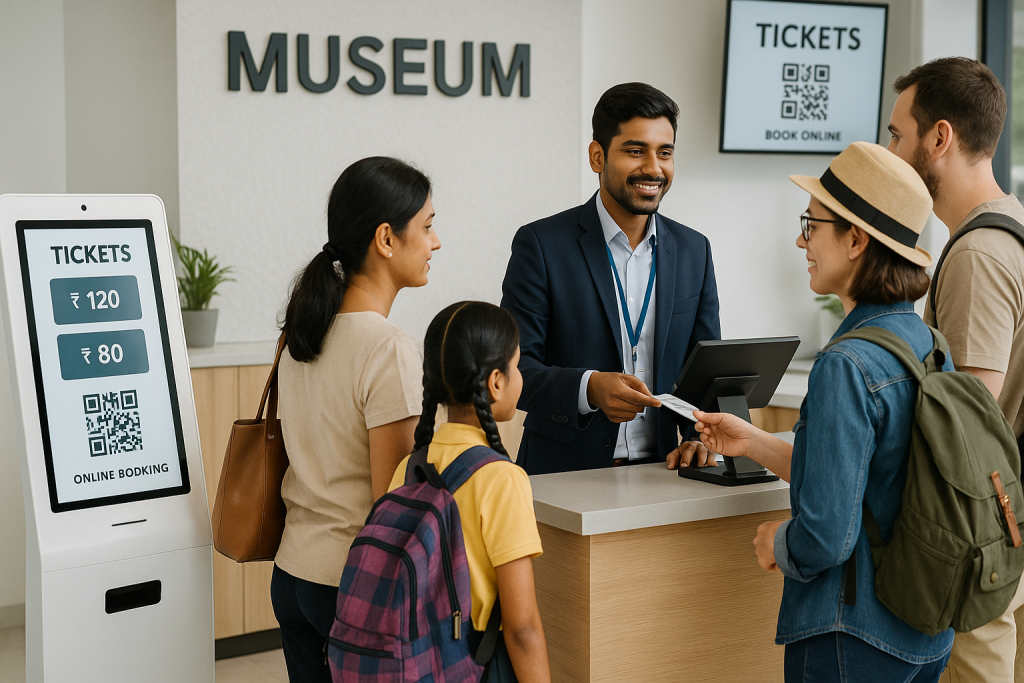
Timed entry, session capacity control, group booking coordination, membership integration, and payment support, including UPI and digital wallets, are all part of the system.
Museums that move to purpose-built digital ticketing systems report up to 80% reduction in administrative workload alongside measurable increases in visitor attendance.
Multi-Location Museum Groups Cannot Run on Fragmented Systems
India’s Ministry of Culture oversees multiple national institutions, including the National Museum, National Gallery of Modern Art, Salar Jung Museum, Victoria Memorial Hall, and institutions under the National Council of Science Museums. Each has its own identity and visitor base.
For groups at this scale, a generic event ticket sales platform creates compounding problems:
- Separate accounts per location with no unified reporting
- Visitor data that cannot be aggregated across sites
- Inconsistent branding on each booking page
- No single dashboard for capacity or revenue tracking
A white-label ticketing platform built for enterprise museum groups centralizes all of this. Individual location controls remain in place, but reporting, branding, and visitor data operate from one system.
The multi-location ticketing challenge is among the most cited operational problems at growing institutions. Adding more accounts on a generic platform does not resolve it.
What Indian Cultural Institutions Are Gaining from Custom Ticket Platforms
Institutions that replace a generic event ticket sales platform with a purpose-built custom ticket platform see direct results:
- 30 to 40% faster visitor entry through QR-based digital ticket scanning
- Higher conversion rates through distraction-free, branded checkout flows
- Improved membership renewal rates when ticketing and membership are connected
- Better group booking management for schools, tour operators, and corporate visits
The Museum of Art and Photography (MAP) in Bengaluru recorded a 40% increase in ticket sales and over 54,000 online bookings after adopting a purpose-built museum ticketing system. The full results are in the MAP ticketing case study.
Revenue also improves when the custom ticket platform connects with donations and membership programs. Institutions build sustainable income through museum revenue diversification that integrates directly with ticketing.
The Features an Enterprise Museum Group Cannot Compromise On
Not all white-label ticketing platforms offer the same depth. For museum chains, these features are non-negotiable:
Branding Control: Full removal of third-party branding from all visitor-facing pages, custom URLs per site, and branded confirmation emails.
Operational Depth: Timed entry and real-time capacity control, group and school booking with custom pricing, on-site POS and kiosk support with offline scanning.
India-Specific Compliance: GST-ready billing, UPI and Rupay integration, and transparent pricing with no hidden per-ticket commission.
Data and Analytics: Real-time sales dashboards per location and across the group, visitor behavior tracking, and CRM integration for re-engagement.
For institutions evaluating options, the museum ticketing software selection guide covers the key criteria in detail.
EveryTicket Gives Museum Groups Full Brand Control from Day One
EveryTicket is a white label ticketing platform built specifically for museums and cultural institutions. It was designed for this sector, not adapted from a general-purpose event ticket sales platform.
For enterprise museum groups, the platform delivers:
- Branded ticketing pages on the institution’s own domain with no third-party branding
- Single dashboard for managing multiple locations, sessions, and exhibitions
- Timed entry, group bookings, and membership integration in one system
- UPI, card, and digital wallet support with GST-ready billing
- Self-service kiosks and POS with offline scanning capability
- Real-time visitor analytics and CRM integration
- Staff training and onboarding at no additional cost
Museums using EveryTicket have reported an increase in revenue and a reduction in queue times.
If your institution manages multiple sites or is currently on a generic event ticket sales platform that restricts your branding, EveryTicket is built for exactly this transition. Explore the platform and book a free demo to see it configured for your institution.
Conclusion
India’s museums are going digital. The question is which platform they choose and what that platform does to their brand in the process.
A white-label ticketing platform gives museums what a generic event ticket sales platform cannot: brand control, visitor data ownership, and operational workflows that match how cultural institutions function.
Institutions that choose the right custom ticket platform build infrastructure that serves them through growth, not just through the next exhibition.
FAQs
What is a white label ticketing platform for museums?
It is a branded ticketing system museums operate under their own identity, powered by a third-party technology backend.
How does a custom ticket platform help museum chains manage multiple locations?
It centralizes ticketing, visitor data, and reporting across all sites under one unified, branded management dashboard.
Why should cultural institutions move away from a generic event ticket sales platform?
Generic platforms display competitor events, dilute institutional branding, and restrict the institution’s ownership of first-party visitor data.
What branding features does a white label ticketing solution include?
Custom domain, logo, colors, fonts, branded confirmation emails, and white-labeled checkout flows across the full visitor journey.
Is a white label ticketing platform affordable for mid-size cultural institutions in India?
Yes. Platforms like EveryTicket offer low setup fees, GST-ready billing, and UPI support built specifically for Indian museums