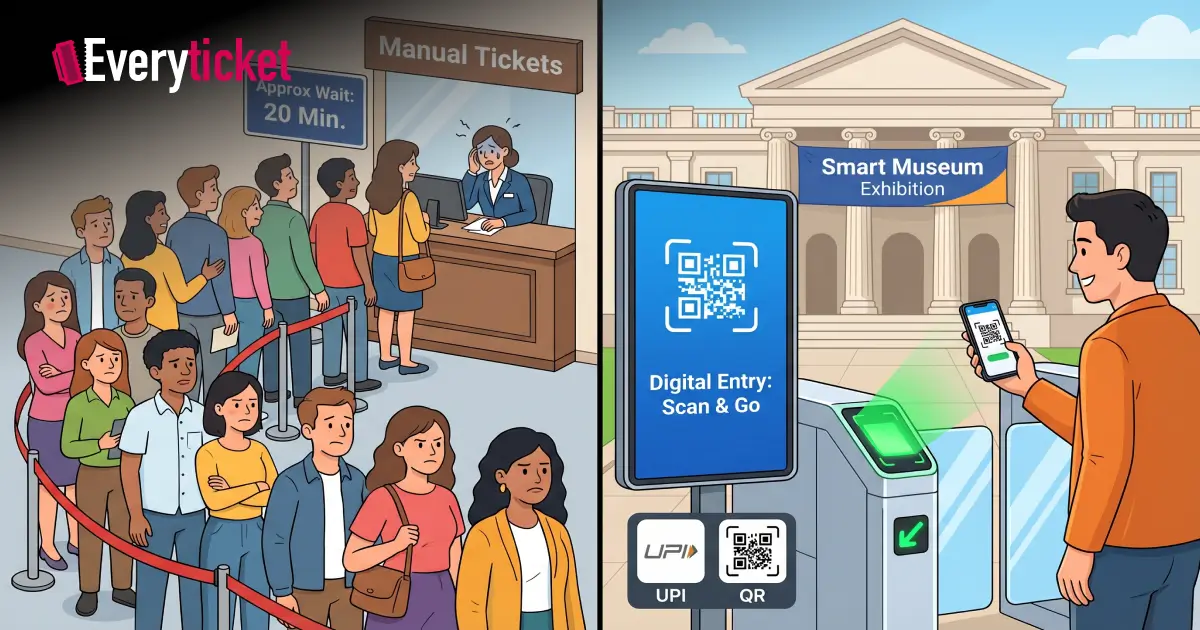
Long queues at the entrance are one of the most consistent complaints visitors make about museums. During school holidays, special exhibitions, or peak weekends, the wait at a manual ticket counter can run 15 to 20 minutes before a visitor gets inside. That delay sets a negative tone before the visit begins.
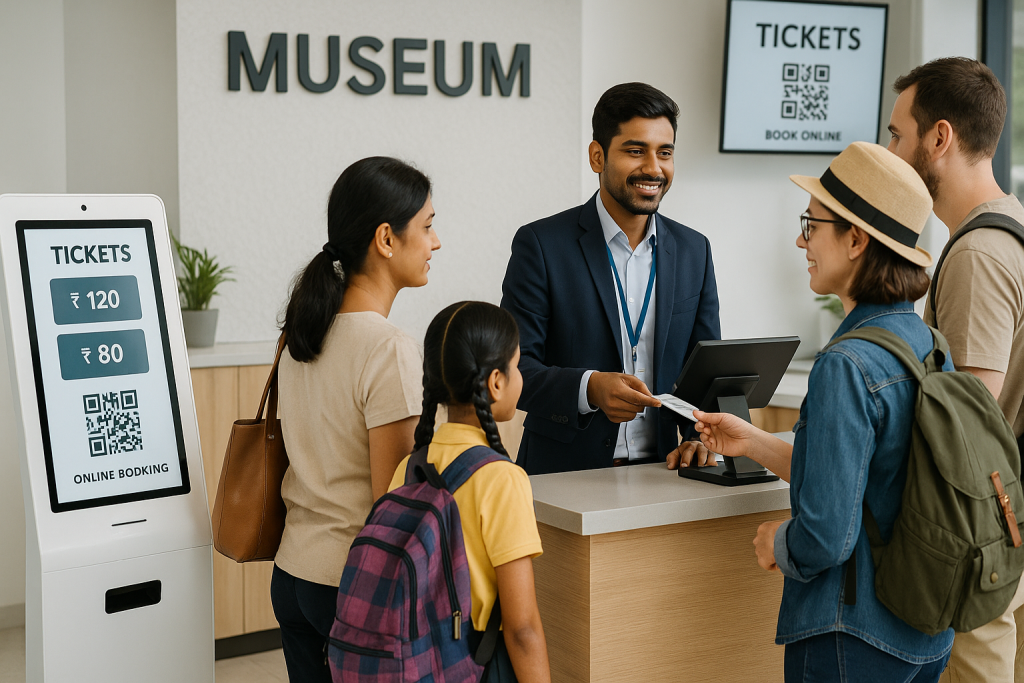
A digital ticketing system removes most of this friction. Visitors book online, receive a QR code, and scan it at the gate. Entry takes seconds. No cash handling. No printed ticket. No manual verification.
For museums across India, where UPI payments and QR scanning are already embedded in daily transactions, this shift is practical and immediate. As of 2025, over 731 million active UPI QR codes are deployed across the country. Visitors already understand how to scan a code to complete a transaction. Museums that adopt a digital ticketing system tap directly into this existing behaviour.
The Real Cost of Manual Ticketing at Museum Entrances
Manual processes at ticket counters create three specific problems that compound on busy days:
- A staff member checking printed tickets or handling cash processes 1 to 2 visitors per minute.
- Without pre-booked slots, there is no way to distribute arrivals evenly across the day.
- Paper logs produce no usable data on peak hours, repeat visitors, or exhibit-level demand.
When a school group arrives at the same time as walk-in visitors, congestion at the entry point can take an hour to clear. The visitor management system approach tackles this at the source by controlling how visitors arrive, not just how they check in.
What a Digital Ticketing System for Museums Actually Does
A digital ticketing system is a software platform that connects ticket sales, entry validation, capacity control, and visitor data into a single automated workflow.
It is different from a basic booking form. A complete system:
- Let’s visitors book and pay online from any device, at any hour
- Issues a unique, encrypted QR code per ticket immediately after payment
- Validates that QR code at the entrance in real time
- Closes time slots automatically when capacity is reached
- Records every entry into a live analytics dashboard
The system links the booking moment to the gate moment. Every step is automated and traceable.
How QR Ticketing at a Museum Entrance Actually Works
QR ticketing for a museum follows a fixed, repeatable sequence. Understanding this flow helps operations teams plan their hardware setup and staff deployment.
Step 1: Booking and Payment
The visitor selects a date, time slot, and ticket type. Payment is processed via an integrated gateway supporting UPI, net banking, and card payments.
Step 2: QR Code Delivery
After payment, the system generates an encrypted, single-use QR code and sends it to the visitor by email or SMS. No app download is required. Modern smartphones scan QR codes natively through the camera.
Step 3: Gate Validation
At the entrance, a handheld scanner or speed gate reads the QR code. The system checks the code against the booking database. A valid ticket opens access in under two seconds.
Step 4: Live Capacity Update
Each scan updates the live entry count for that time slot. The system prevents overbooking without any staff intervention.
Step 5: Analytics Feed
Every entry is logged. Museum managers see visitor counts, peak arrival windows, and slot utilisation from the dashboard without manual tallying.
Research published in Information Technology and Tourism confirms that this type of timed entry, backed by a data-driven booking system, can eliminate entrance queuing entirely during peak periods when correctly configured.
The Technical Stack a Smart Museum Needs
A complete digital ticketing system built for contactless entry includes:
- Booking engine: Time slot selection with UPI, card, and wallet payment support
- QR code generator: Encrypted, single-use codes tied to each booking record
- Entry scanner or speed gate: Hardware that reads QR codes and validates against the database in real time
- Visitor management software: Controls capacity per slot, manages group arrivals, and logs all entries
- Analytics dashboard: Reports on visitor counts, peak hours, and slot performance
- CRM link: Connects entry data to membership records, repeat visit tracking, and communication tools
Museums that want these tools connected without custom development benefit from API-integrated platforms built specifically for cultural institutions.
By the Numbers: What QR Ticketing Delivers for Museums
The performance data on contactless entry is direct.
One cultural institution in India cut average entry wait time from 11 minutes to under 3 minutes after switching to QR-based entry. Reduced queue time also increased on-site spending because visitors arrived at exhibits with energy rather than frustration.
Institutions using automated ticketing systems report a 30% reduction in time spent on ticketing-related tasks. Visitors who use digital ticketing are up to 43% more likely to return for a second visit, based on data from research conducted by ACME Ticketing.
For museum revenue, this impact extends well beyond the entry gate. A museum ticketing system that boosts revenue drives higher daily throughput, fewer no-shows through automated reminders, and more on-site spending per visitor.
What Smart Museums Should Require from Their Ticketing Platform
Not every ticketing tool is built for museum operations. A system designed for general events will lack the features cultural institutions need. Key criteria to evaluate:
- Timed entry with auto-closure: Slots must close automatically when full, without manual oversight
- UPI and multi-payment support: Museums that limit payment options lose bookings from visitors who prefer digital wallets
- Real-time capacity control: Managers need live entry counts, not end-of-day summaries
- Group and school booking management: Bulk booking, custom arrival windows, and headcount tracking
- Cloud-based access: Staff manage the system from tablets or front-desk devices without local server infrastructure
- POS and CRM integration: Ticketing data connects to on-site retail and visitor relationship management
Museums should also assess self-service kiosk support, which extends contactless access to walk-in visitors who prefer to book at the venue rather than online.
A Phased Implementation Path That Works for Museum Teams
Museums moving from manual ticketing to a digital ticketing system do not need to overhaul operations at once. A phased approach keeps disruption low.
Phase 1: Enable online booking with UPI and card payments. Issue QR codes via email and SMS.
Phase 2: Install handheld QR scanners at the main entry point. Train front-desk staff on the management dashboard.
Phase 3: Add timed entry slots with automatic capacity control. Shift walk-in visitors toward pre-booking through clear on-site signage.
Phase 4: Connect ticketing data to CRM. Use entry patterns to plan staffing, schedule exhibitions, and target repeat visitors.
As MuseumNext research notes, QR codes are now native to modern smartphones, meaning visitors need no additional app. This removes one of the most common adoption barriers museums worry about.
For museums that run both online and on-site ticket sales, combining online booking with a POS system keeps both channels unified under one platform with no data duplication.
EveryTicket Gives Museums Everything They Need in One Platform
EveryTicket is built for museums. The platform includes online booking with UPI and multi-payment support, encrypted QR code generation and scanning, timed entry management with automatic slot control, real-time capacity dashboards, POS integration, and CRM linkage. Museums go live in days with full staff training and no IT team required.
If your museum is evaluating a digital ticketing system for contactless entry, EveryTicket covers the full technical stack with dedicated local support.
Conclusion
Entry delays have a direct solution. A digital ticketing system that issues encrypted QR codes, validates them at the gate in real time, and manages visitor capacity by time slot removes the friction that frustrates visitors before they see a single exhibit. Smart museums across India are adopting this approach because the infrastructure is already in place: UPI adoption is widespread, smartphone usage is high, and visitor expectations have shifted permanently toward contactless access. Implementation is the final step.
FAQs
What is a digital ticketing system for museums?
A software platform that manages online ticket sales, QR code generation, contactless gate validation, and visitor analytics in one system.
How does QR ticketing reduce entry delays at a museum?
QR ticketing validates each ticket in under two seconds at the entry gate, removing manual checks and cutting average wait times significantly.
Does a digital ticketing system support UPI payments for museums in India?
Yes. Modern museum ticketing platforms integrate UPI, credit cards, debit cards, and mobile wallets directly into the booking checkout flow.
What hardware does a museum need to enable QR-based contactless entry?
Museums need QR scanners or speed gates at entry points, a cloud-based ticketing platform, and a front-desk or tablet device for the management dashboard.
How long does it take a museum to go live with a digital ticketing system?
Most cloud-based museum ticketing platforms can be fully configured and operational within a few days, with staff training provided.