Online museum ticketing through a direct channel eliminates the per-ticket commission that flows to aggregators and returns full revenue to the institution. When a visitor books through a third-party platform, a percentage of every sale leaves permanently. At 2,000 tickets per month at a 10% commission rate on a ₹150 ticket, that is ₹3,60,000 leaving the institution annually without a single operational improvement in return.
I speak with museum finance heads who accept this cost as a fixed line item. It does not have to be. The technology to manage tickets for museums online, without an aggregator in the chain, is accessible, India-compliant, and deployable in days, not months.
Key Takeaways
– Third-party aggregators typically extract 8-15% commission per ticket, compounding into significant annual revenue loss for high-footfall museums.
– Direct online museum ticketing lets institutions retain 100% of every ticket sale with no per-transaction deduction.
– Visitor data, including contact details and booking history, belongs to the aggregator when bookings go through their platform, not the museum.
– A purpose-built event ticket sales platform for museums handles timed entry, capacity management, GST invoicing, and UPI payments natively.
– Switching to a direct ticketing system requires a flat monthly subscription rather than a variable per-ticket commission structure.
What third-party aggregators extract from online museum ticketing
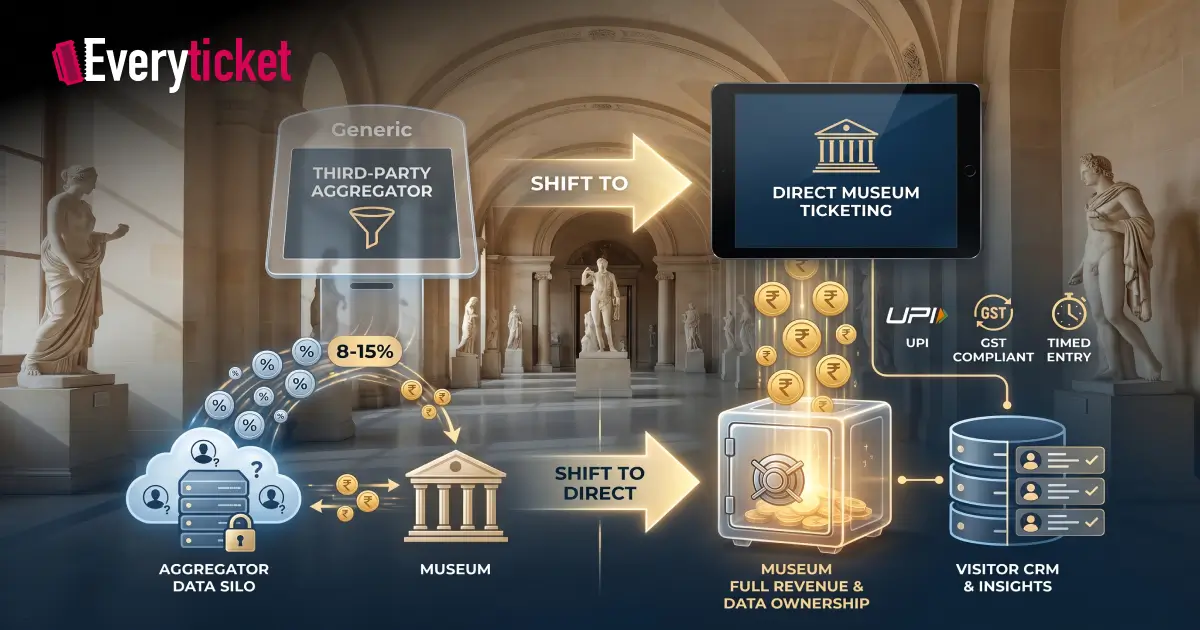
Most aggregator agreements for cultural venues carry a per-ticket commission between 8% and 15%. On a ₹150 adult ticket, ₹12 to ₹22.50 per booking goes to the aggregator. At 2,000 bookings per month, the annual cost sits between ₹2.88 lakh and ₹5.40 lakh, depending on the contracted rate. Heritage sites and government museums with higher footfall lose proportionally more.
The revenue loss appears on every settlement statement. The secondary cost is less visible. When a visitor books through an aggregator, their name, email address, and booking history belong to the aggregator. The institution admits the visitor at the gate and receives no record of who that visitor was. There is no foundation for a membership offer, a repeat visit campaign, or a donor conversion.
Museums that shift to direct online museum ticketing own both the transaction and the visitor record. That difference compounds across every booking made.
How direct online museum ticketing returns full revenue
A direct online ticketing setup removes the aggregator entirely. The visitor books through the museum’s own portal. Payment processes through an integrated gateway. The institution receives the full ticket value, minus standard payment gateway fees of 1.5-2%, rather than an 8-15% commission. On the same ₹150 ticket, the museum retains ₹147 instead of ₹135 at minimum.
This is not a marginal improvement. I have seen museums with 3,000 monthly online bookings maximize museum revenue by over ₹6 lakh annually simply by moving transactions off an aggregator-managed channel and onto their own. That figure does not include the downstream value of visitor data and CRM capability the museum gains simultaneously.
The Ministry of Culture, Government of India has consistently supported digital self-service for ticketed monuments and heritage institutions as part of the national digital infrastructure push. A direct booking portal aligns with that direction while eliminating the commercial intermediary from the revenue path.
Managing tickets for museum online without an aggregator
The reason many museums continue to use aggregators is not preference. It is that they do not have an alternative system to manage tickets for museum online that handles the complete workflow independently. Aggregators bundle technology with their commission structure. Remove the aggregator without a replacement, and the operational gap becomes a problem.
A complete direct ticketing system covers:
Online booking portal
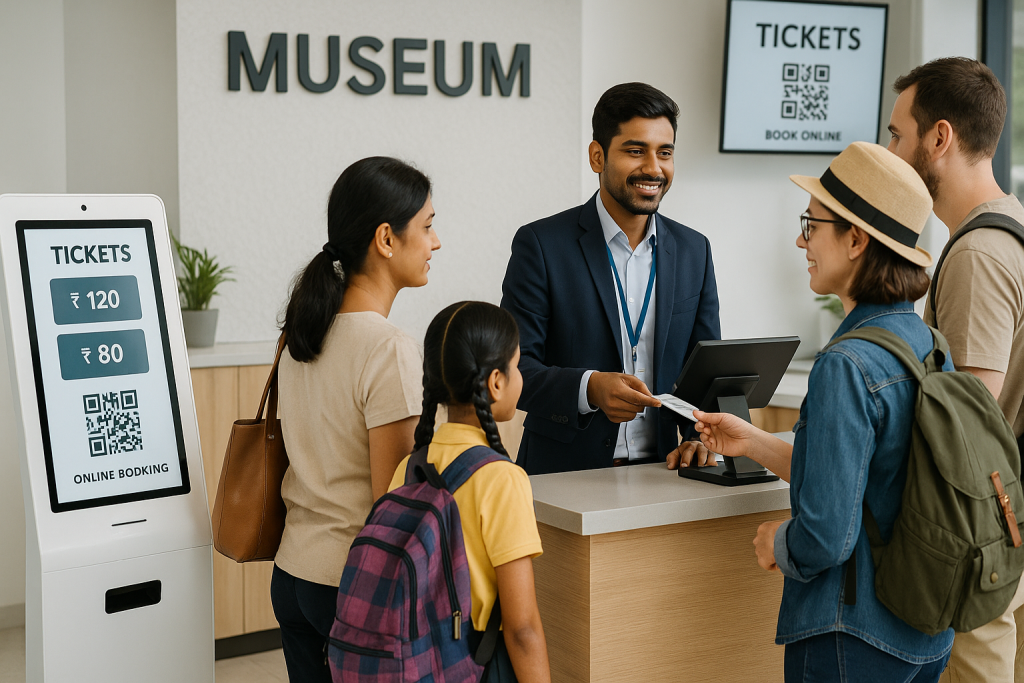
A mobile-friendly, custom-branded booking page where visitors purchase in advance, select time slots, and receive digital tickets with QR codes. No aggregator interface, no external branding, no commission.
Timed entry and capacity management
Time slots configured per entry window, with automatic closure when capacity is reached. This is what prevents the aggregator from overselling your venue.
Payment processing
UPI, card, and cash handled within the same platform, with GST-compliant invoicing generated on every transaction. Government museums cannot route transactions through systems that do not produce audit-ready GST output.
Entry validation and visitor data
QR-code scanning at gates under one second, with real-time occupancy tracking and visitor profiles built from every booking. This is the CRM layer that aggregators withhold.
Why a purpose-built event ticket sales platform outperforms aggregators
A generic aggregator processes ticket sales. A purpose-built event ticket sales platform manages the entire operational picture: scheduled admissions, special exhibition ticketing, school group bookings, and membership validation, all in a single dashboard with shared inventory.
The distinction becomes critical when a museum runs a special exhibition alongside regular admissions. A general aggregator treats both as separate events with independent inventory and separate settlement cycles. A museum-specific event ticket sales platform integrates them under one capacity framework, preventing conflicts and giving the operations team a unified view of daily revenue and footfall.
The International Council of Museums notes that digitising visitor access data enables institutions to make better programming decisions, improve conservation planning, and build audience relationships that support long-term sustainability. None of that is possible when visitor data sits in a third-party database.
The best ticketing platforms in India for museums combine this operational depth with India-specific compliance: UPI support, GST invoicing, multi-category pricing for Indian nationals, foreign nationals, and SAARC visitors, and offline POS mode for venues where internet connectivity is inconsistent.
Own your ticketing: talk to our team
We built EveryTicket specifically for institutions ready to move online sales off aggregator platforms and onto a direct, museum-controlled channel. The platform goes live for online bookings in 60 minutes and deploys fully in 30 days. There are no per-ticket commissions on any plan. Museums retain 100% of every ticket sold. Plans start at ₹7,000/month.
If you want to see what the revenue impact looks like at your current ticket volume, the calculation takes ten minutes. Talk to our team and we will run it with you.
Conclusion
Museums that rely on aggregators for online museum ticketing are paying to rent access to their own visitors. Direct ticketing returns that revenue to the institution, and with it, the visitor data that makes membership conversion, repeat visits, and long-term audience development possible. The ability to manage tickets for a museum online through an owned platform also closes the compliance gap: GST invoicing, UPI support, and audit-ready reporting are built into the right event ticket sales platform from the start, not bolted on as an afterthought. For institutions still operating through third-party channels, the cost of the shift is a flat monthly subscription. The cost of not shifting is a commission line that grows with every booking.
FAQs
What is online museum ticketing, and how does it work for direct sales?
Visitors book through the museum’s own portal, pay online, and receive a QR-coded digital ticket for direct entry.
Why do Indian museums pay aggregator commissions when direct ticketing exists?
Most lack a ready alternative system. Once a direct event ticket sales platform is in place, the aggregator becomes unnecessary.
What does it cost to manage tickets for a museum online through a direct platform?
Direct platforms charge a flat monthly fee starting around ₹7,000 with zero per-ticket commissions, regardless of booking volume.
Does a direct event ticket sales platform support both regular admissions and special exhibitions?
Yes, purpose-built platforms manage regular admissions and special exhibitions from one dashboard with shared capacity controls and unified reporting.
Does direct online museum ticketing support GST invoicing and UPI payments?
Purpose-built Indian platforms generate GST-compliant receipts automatically and support UPI natively from the first transaction.