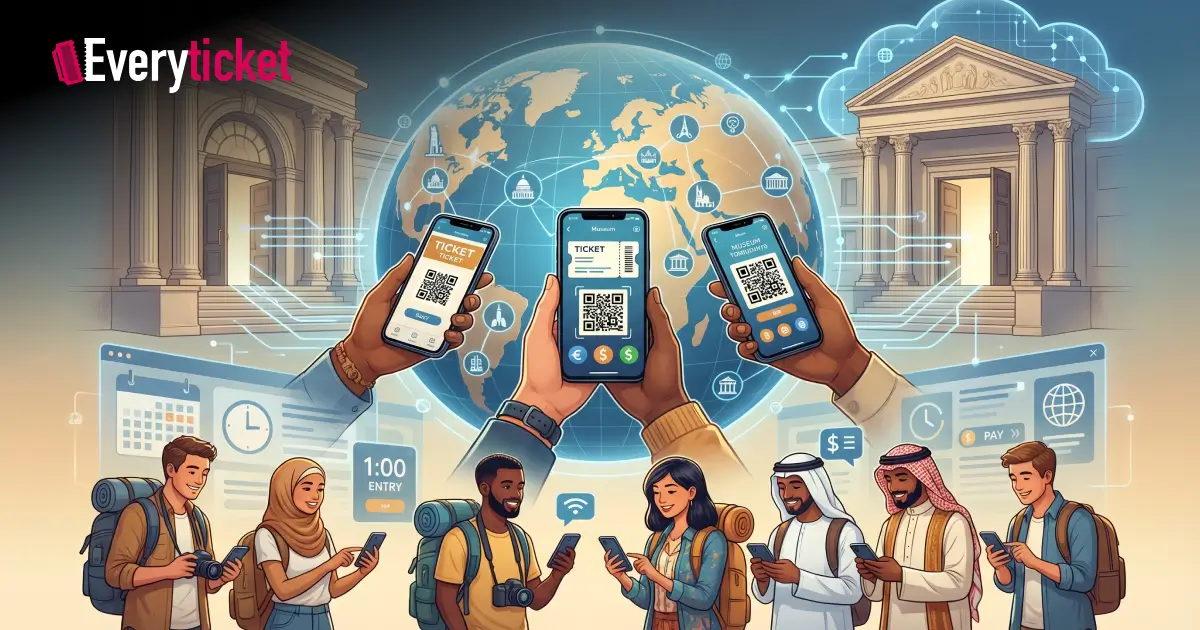
Cultural institutions have always drawn curious minds from across the world. But curiosity alone does not fill seats, accessibility does. And in a world where travellers plan, book, and pay for experiences entirely on their phones before stepping foot on a plane, a museum without a robust online ticketing service is, quite simply, invisible to the international visitor.
This is the core challenge facing tourism museums today. Despite housing irreplaceable heritage, breathtaking art, and centuries of story, many cultural institutions continue to operate ticketing systems designed for walk-in footfall, not for the digital-first, globally mobile visitor who discovered their museum on Instagram at 11 PM in a timezone seven hours away.
Here, we have explained a clear strategy for how museums can use online ticket services to meaningfully expand their global visitor access, and what capabilities truly make the difference between a local attraction and an internationally bookable destination.
The Global Visitor Access Gap: Why Museums Are Being Left Behind
The global museum sector has staged a remarkable recovery since the disruptions of 2020–2021. According to the International Council of Museums (ICOM), global museum visits surpassed 900 million annually in 2024, driven by renewed cultural demand and the full resurgence of inbound international tourism. Major institutions across Europe and Asia are approaching, and in many cases exceeding, pre-pandemic visitor numbers.
Yet a structural gap persists between where visitors are and how museums reach them.
A 2024 market research report by Marketintelo reveals that online museum ticketing now represents approximately 62.8% of all market revenues in 2025, a seismic shift from just a few years ago when box office walk-in sales predominated. The same report notes that a visitor preference survey conducted across 18 countries found that 74% of respondents preferred to purchase museum tickets online in advance, while 53% specifically sought the option to select timed-entry slots to avoid long queues.
The message is unambiguous: international visitors overwhelmingly prefer to book digitally, in advance, on their terms.
And yet, across many cultural tourism destinations, this preference goes unmet. Less than 40% of tourist sites currently offer integrated services like online ticketing and multilingual information, limiting convenience for both domestic and foreign visitors, according to a 2025 analysis of India’s travel and tourism sector. This gap does not just inconvenience visitors, it actively redirects them to destinations that have solved the problem.
Museums that lack a capable online ticketing service are not simply missing a digital upgrade. They are missing visitors, revenue, and international relevance.
Why International Visitors Choose Museums That Book Online
Understanding the modern international visitor’s journey is critical before designing any global access strategy.
A tourist planning a cultural trip does not begin their journey at your ticket counter. They begin it weeks earlier, on Google, on TripAdvisor, on Klook, on Instagram, and they make booking decisions in that same digital space. If your museum cannot be discovered, pre-booked, and paid for within a few taps, they move on to an attraction that can.
According to Marketintelo’s Museum Ticketing Systems Market Research Report 2034, mobile devices now account for approximately 47% of all online museum ticket purchases globally in 2025. Museums with robust online ticketing portals reported an average of 23% higher per-visitor revenue compared to walk-in-only institutions, primarily driven by superior cross-sell and upsell capabilities during the digital checkout flow.
Beyond revenue, there is a visitor experience argument that is just as compelling. International visitors face amplified friction at physical ticket counters, language barriers, unfamiliar payment methods, uncertainty about availability, and the very real fear of travelling across cities or countries only to find a venue sold out. A well-configured online ticketing service eliminates every one of these barriers before the visitor arrives.
The shift to advance online booking also enables museums to implement timed-entry systems that distribute visitor load more evenly throughout the day, reducing peak hour crowding by an estimated 31% at leading institutions, creating a better experience for every visitor, domestic or international.
6 Strategic Pillars of a Global-Ready Online Ticketing Service
Not all online ticketing solutions are built for global reach. A booking widget bolted onto a museum’s homepage is not the same as a fully integrated, internationally facing ticketing strategy. For museums serious about expanding their global visitor access, the following six pillars are non-negotiable.
1. OTA and Reseller Channel Integration
Online Travel Agencies (OTAs), platforms like GetYourGuide, Klook, Viator, and TripAdvisor Experiences, are where international tourists actively search for, discover, and book cultural experiences in cities they plan to visit. These platforms operate massive global audience networks, spending heavily on international marketing that an individual museum could not replicate independently.
For museums, connecting to OTA channels through an online ticketing service is the single highest-leverage action for expanding global reach. As the Blooloop Museum Best-Practice Ticketing Guide notes, “OTAs are a fantastic way of expanding the reach of international and non-local visitors,” particularly for city-based and destination museums.
The mechanics matter here. The best OTA integrations maintain live, real-time inventory synchronisation, meaning tickets sold via Klook or Viator are instantly reflected in your central ticket pool. This prevents overbooking and gives your team unified visibility. Look for an online ticketing service that manages all reseller relationships from a single dashboard, automatically syncing availability and pricing across all channels.
This is also where EveryTicket’s advanced API integrations become strategically critical, enabling museums to connect their ticketing system to external distribution channels without manual reconciliation or data silos.
2. Google Things to Do Integration
Separate from OTAs, Google Things to Do is a direct ticket purchase pathway embedded within Google Search and Google Maps, arguably the world’s most visited discovery platform. When a traveller searches for “museums to visit in [city]” and your institution appears in results with a direct “Buy Tickets” button, you have eliminated one of the biggest drop-off points in the visitor journey.
According to Marketintelo’s market research, integration with popular booking aggregators, including Google Things to Do, has emerged as a key differentiator, allowing forward-thinking museums to capture demand from international tourists who discover and book cultural experiences directly without leaving the Google ecosystem.
Museums that connect their online ticketing service to Google Things to Do gain meaningful SEO and conversion advantages that compound over time.
3. Multilingual Booking Interfaces
Language is one of the most overlooked barriers to international conversions. A visitor from Japan, France, Germany, or South Korea may have a deep interest in your museum, but if your booking flow is available only in English, you create unnecessary friction at the exact moment you need the least resistance.
A globally capable online ticketing service must support multiple interface languages, not just English, but key international visitor languages relevant to your inbound tourist profile. For heritage-rich destinations drawing visitors from across Europe and East Asia, this typically means supporting French, Spanish, German, Japanese, Chinese, and Korean at a minimum, alongside regional domestic languages.
Cuseum’s research on museum technology solutions highlights how digital tools that extend beyond physical limitations, including language accessibility, are becoming a standard expectation rather than a premium feature for international museum audiences.
Multilingual capability is not just a visitor-facing courtesy. It is a conversion optimisation tool.
4. Multi-Currency and Global Payment Gateway Support
Even if a visitor successfully finds your museum, navigates a multilingual booking interface, and selects their date and time slot, an inability to pay in their native currency or using their preferred payment method will kill the transaction.
International visitors expect to pay with global credit and debit cards (Visa, Mastercard, American Express), digital wallets (Apple Pay, Google Pay, PayPal), and in some cases, region-specific payment apps. Simultaneously, domestic visitors in many South Asian markets rely heavily on UPI, the world’s fastest-growing real-time payment network.
A globally ready online ticketing service must bridge both worlds seamlessly. As the Growth Market Reports analysis of the Museum Ticketing Platform market notes, ticketing platforms that offer multilingual support and seamless integration with international and regional payment systems are “increasingly sought after” as museums seek to cater to diverse international audiences.
This dual-payment capability, supporting UPI, cards, and global wallets without requiring visitors to adapt to your infrastructure, is a foundational requirement for museums with genuine international ambitions.
5. Mobile-First Booking Experience with Real-Time Availability
With nearly half of all online museum ticket purchases globally now completed on mobile devices, a booking experience that is not optimised for smartphones is not truly online. It is simply inaccessible to a large portion of the global audience.
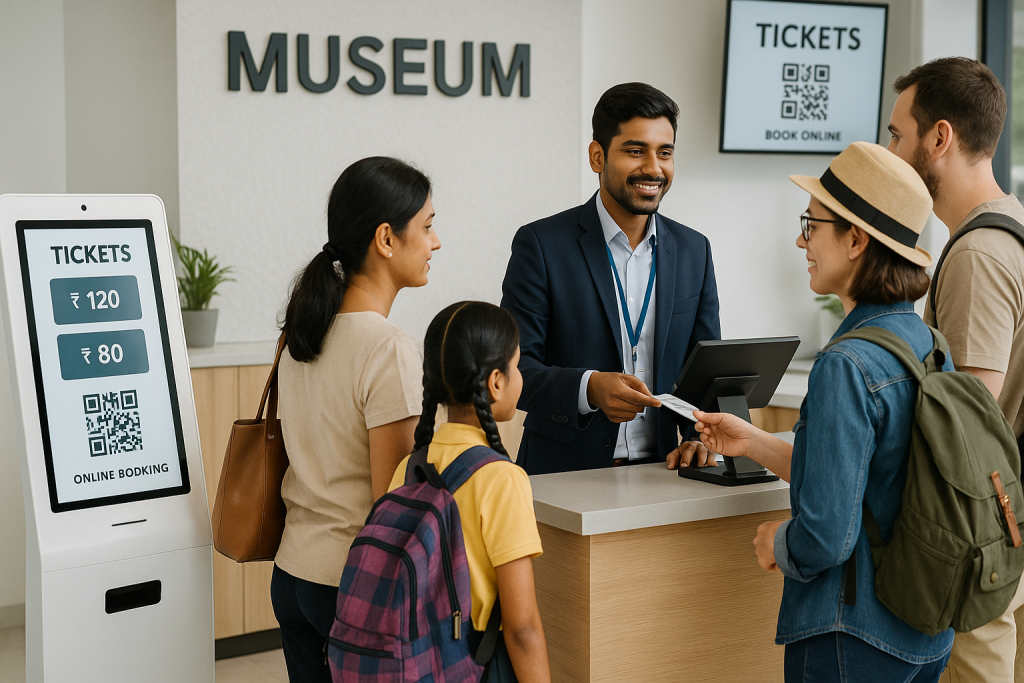
A mobile-first online ticketing service for museums should deliver: a fast, uncluttered booking flow that completes in under three minutes; real-time availability showing open time slots across calendar dates; instant QR-code ticket delivery via SMS, WhatsApp, or email; and a zero-friction check-in experience that works across device types.
Real-time availability is particularly important for international visitors, who often plan visits weeks in advance and need confidence that a slot is actually confirmed, not tentative. This is especially true for high-demand exhibitions and weekend visits. Offering visible, bookable time slots through a complete online and on-site unified ticketing system gives international visitors exactly the assurance they need to commit.
6. International Visitor Data Capture for Ongoing Marketing
Every international visitor who books through your online ticketing service is a data asset, but only if your system is configured to capture, segment, and activate that data.
A global-ready ticketing platform should collect visitor origin, language preference, booking channel, ticket type, and visit timing, and make this data available in an accessible analytics dashboard. Over time, this intelligence reveals which international markets are already discovering your museum organically, where paid OTA investment is converting, and which visitor segments are likeliest to return or recommend.
According to the Future Market Insights Museum Tourism Sector Report, global institutions have increasingly observed that digital engagement drives on-site interest, meaning the data loop between online ticketing and targeted re-marketing is one of the most direct pathways to sustained international attendance growth.
This is why CRM-integrated museum ticketing platforms are so valuable; they ensure that every booking, from every channel, builds a unified visitor profile that informs smarter global marketing decisions.
The South Asian Context: A Growing Inbound Opportunity with a Digital Gap
Few regions illustrate the opportunity and the urgency of global-ready online ticketing more clearly than South Asia.
India welcomed 9.66 million international tourist arrivals in 2024, a 4.7% increase over 2023, according to road-level tourism statistics. The country’s Ministry of Tourism projects international arrivals to reach 20 million by 2025, supported by expanding air connectivity, a growing middle class of outbound-then-returning visitors, and a heritage tourism sector of extraordinary global appeal.
The domestic picture is even larger. In 2023, India recorded over 2.5 billion domestic tourist visits, with cultural and heritage tourism forming a significant component, and that figure continues to grow.
The opportunity is real. So is the gap.
Despite this tourism momentum, analysis of India’s travel and tourism sector reveals that fewer than 40% of tourist sites currently offer integrated online ticketing, meaning the majority of cultural attractions, including many museums of national and international significance, are still turning away the global visitor at the point of digital discovery.
The government’s own roadmap acknowledges this, mandating widespread implementation of integrated ticketing, multilingual mobile apps, and virtual guides across tourist sites by 2027. Museums that move now are not just ahead of a trend, they are positioned to capture an inbound opportunity that institutions with outdated systems will miss entirely.
There is also an important domestic convenience layer. With over 750 million smartphone users and a UPI ecosystem processing billions of transactions monthly, digital payment behaviour is deeply normalised. A museum that combines UPI support for domestic visitors with global payment gateway access for international tourists covers the full spectrum of the modern visitor’s payment expectations.
How the Right Online Ticketing Service Translates to Revenue
The global visitor access argument is compelling. The revenue argument makes it urgent.
Museums with modern, internationally configured online ticketing services consistently outperform walk-in-first institutions across every meaningful financial metric. According to Marketintelo’s comprehensive market analysis, institutions using modern cloud-based ticketing systems in 2025 reported:
- Up to a 28% increase in advance ticket sales versus those on legacy systems
- A 19% improvement in visitor satisfaction scores
- 23% higher per-visitor revenue from online channels versus walk-in, driven by digital upselling opportunities (guided tour add-ons, special exhibitions, café vouchers) built into the checkout flow
Beyond per-visit metrics, international visitors tend to generate higher total spend per visit, more likely to purchase audio guides, exhibition supplements, museum shop items, and memberships when these are made available as seamless add-ons during the online booking journey.
This is exactly the territory covered in detail in EveryTicket’s analysis of museum revenue diversification strategies, where digital ticketing is positioned not just as an admissions tool, but as the revenue engine that activates multiple income streams simultaneously.
Real-world outcomes reinforce this. The Museum of Art & Photography (MAP) in Bengaluru, one of India’s most ambitious cultural institutions, adopted a comprehensive digital ticketing approach and achieved a 40% increase in ticket sales, a 60% reduction in entry times, and a 30% increase in membership sales.
The full findings of this digital transformation case study demonstrate what is possible when a museum treats its online ticketing service as a strategic investment rather than an operational afterthought.
What to Look for in an Online Ticketing Service for Global Reach
Not every online ticketing service is built with international ambitions in mind. Before selecting or upgrading a platform, museum directors should evaluate candidates against the following capability checklist:
Discoverability and Channel Distribution
- OTA integrations with major international platforms
- Google Things to Do compatibility for direct-from-search booking
- API-driven inventory synchronisation across all sales channels
Visitor-Facing Experience
- Multilingual booking interface (English + key international languages)
- Mobile-first design with sub-3-minute booking completion
- Multi-currency display with global payment gateway support (cards, Apple Pay, Google Pay, PayPal)
- Instant QR-code ticket delivery via WhatsApp, SMS, and email
Operational Integration
- Unified dashboard for online and on-site (POS/kiosk) sales
- Real-time availability and timed-entry management
- Compliance with local tax and payment regulations (GST, UPI for domestic markets)
Data and Marketing
- Visitor origin, language, and channel tracking
- CRM integration for visitor segmentation and re-marketing
- Exportable reports for attendance, revenue, and channel performance
Support and Scalability
- Cloud-based architecture requiring no on-site IT infrastructure
- Rapid setup and staff training
- Dedicated support without hidden costs
Reviewing this checklist against your current setup, or against any platform you are evaluating, is the fastest way to identify where your global reach strategy currently has gaps.
For a deeper look at how to structure the evaluation process, EveryTicket’s guide to choosing the right museum ticketing software walks through the decision framework in detail.
Ready to Make Your Museum Globally Bookable?
If your museum’s collections deserve an international audience, and they do, the first step is ensuring that international visitors can actually find, book, and arrive without friction.
EveryTicket is a museum-first online ticketing service built specifically for cultural institutions, combining online booking, POS, kiosk support, analytics, and CRM in a single unified platform. It is GST-compliant, UPI-ready, and configured to support the full range of domestic and international visitor payment preferences, making it equally capable of serving a family from the next city and a traveller flying in from abroad.
If you are ready to expand your museum’s global visitor access, explore EveryTicket’s platform or speak with our team directly to see how it fits your institution’s specific needs.
Conclusion
Global visitor access is not an aspiration reserved for large, well-funded institutions. It is a strategic outcome that any museum can achieve when its online ticketing service is built to remove, rather than reinforce, the barriers that separate international visitors from your doors.
The data is clear: the majority of the world’s museum-going audience now plans and purchases digitally. The destinations capturing this audience are the ones that show up in OTA searches, load flawlessly on mobile, communicate in the visitor’s language, and accept payment in their currency.
For museums with rich collections and underserved global potential, the path forward is not a complete operational overhaul. It starts with a single strategic upgrade: an online ticketing service configured not just for the visitor standing at your counter, but for every curious traveller who has not yet decided to visit, and who is making that decision right now, on their phone, on the other side of the world.
FAQs
What is an online ticketing service for museums?
A digital platform that lets visitors book, pay for, and receive museum tickets online before their visit, from anywhere in the world.
How does online ticketing help museums reach global visitors?
It enables 24/7 bookings, multilingual support, and OTA integrations that make museums discoverable and bookable by international tourists.
Can museums accept international payment methods through online ticket services?
Yes. Modern platforms support global credit cards, PayPal, Apple Pay, and Google Pay alongside domestic options like UPI.
What is OTA integration in museum ticketing?
It connects your ticketing inventory to platforms like Klook, Viator, and GetYourGuide for worldwide visitor discovery and booking.
How does online booking increase a museum’s advance ticket sales?
It gives visitors the convenience to plan visits ahead, reducing reliance on walk-ins and boosting predictable, advance revenue significantly.