A digital ticketing solution is software that lets a museum sell tickets, admit visitors, record every payment, and report on all of it from one system. That is the whole idea, without the jargon. If you sit on a board or trust, or you have just stepped into a director’s role, you do not need a technical background to make a sound decision about digital ticketing solutions. You need to know what the system does, why it affects the museum’s money, and what to ask before you approve it. I work with Indian museums on this every month. I have watched capable boards delay a good decision because no one explained the move off a manual counter in plain language. Online museum ticketing is not complicated once you see what sits underneath it. This guide gives you that, in five minutes.
Key Takeaways
– A digital ticketing solution sells tickets online and at the counter, validates entry by QR code, and records every transaction in one place.
– Footfall at India’s ticketed monuments rose over 19% from 2019-20 to 2023-24, yet ticket revenue fell, a gap a digital system is built to close.
– For a board, this is a financial-control and audit decision, not only an IT upgrade.
– A strong solution works offline, issues GST-compliant invoices, and runs every sales channel from a single dashboard.
– You can judge a vendor with five plain questions, no technical knowledge required.
What a digital ticketing solution actually is
Strip away the marketing and a digital ticketing solution does four jobs. It sells a ticket, it proves that ticket is real at the door, it records the money, and it turns all of that into a report you can trust. A paper roll and a card machine do the first job only. Everything after the sale stays manual.
Here is the difference in practice:
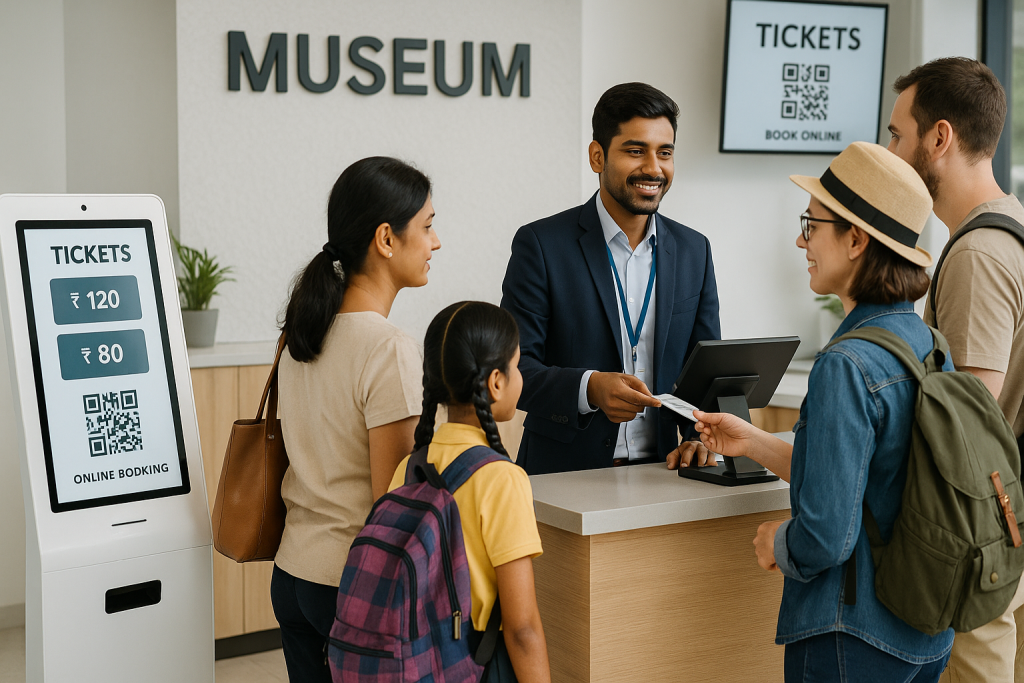
- Selling: visitors buy online before arrival or at the counter, by UPI, card, or cash.
- Validating: each ticket carries a QR code, scanned at entry in about a second, so duplicates and fakes do not get through.
- Recording: every sale is logged by category the moment it happens, not reconstructed at closing time.
- Reporting: the museum sees revenue, footfall, and capacity on one dashboard, in real time.
This is what people mean by online museum ticketing, and by digital ticketing more broadly. Once a board sees the four jobs laid out, the advantages of going digital stop sounding abstract.
Why digital ticketing solutions reached the board’s agenda
Here is the number that should matter to any trustee. Footfall at India’s centrally protected ticketed monuments rose more than 19% between 2019-20 and 2023-24, yet ticket revenue across those same sites fell over the period. More visitors, less money collected. That gap is what a manual counter quietly produces: untracked cash, miscounted entries, and tickets that never make it into a record.
A digital ticketing solution closes that gap because the money and the visitor count are captured at the same moment. For a board, that reframes the conversation. This is not a purchase the IT person handles alone. It is financial control, audit-readiness, and visitor data, which are board concerns. Modernising how a museum runs usually starts here, at the till, because that is where the leakage is.
A digital ticketing system is more than selling tickets online
A “buy tickets” button on a website is a point tool. A digital ticketing system is the whole record. The distinction matters more than it sounds.
With a point tool, online sales sit in one place and counter sales in another, and someone still merges them by hand. A digital ticketing system keeps online, counter, and kiosk sales in a single record, so the daily settlement matches the cash actually taken. It generates GST-compliant invoicing automatically, which a government museum needs for audit, not as a nicety. It enforces capacity by closing a time slot when that slot is full. And it keeps working offline at the counter, then syncs when the connection returns, because museum connectivity is rarely reliable all day.
That is why a digital ticketing system, rather than a booking widget, is what a serious institution should be evaluating.
How a non-technical board member can judge digital ticketing solutions
You do not need to assess code to assess a vendor. Ask five questions, and listen for specifics.
- Does the counter keep working when the internet drops? If not, every outage becomes lost sales.
- Does it produce a GST-compliant invoice on every ticket, automatically? Manual GST is an audit risk.
- Is every sales channel on one dashboard? Separate systems mean someone reconciles by hand.
- Is the price flat, or per ticket? Per-ticket fees grow as the museum succeeds; flat pricing does not.
- Can the vendor name an Indian institution it already runs? If it cannot, that is a data point.
Government reviews have repeatedly found that visitor facilities and ticketing at India’s monuments remain uneven and under-resourced. The right questions stop a museum from buying the same problem in digital form.
If you want a longer checklist to take into the meeting, our guide to choosing the right platform goes further.
How we help boards make the case
We built EveryTicket for this exact decision. It runs online booking, counter POS, and kiosks from one dashboard, issues GST-compliant invoices by default, supports UPI from day one, and keeps selling at the counter when the connection drops. We have processed over 150,000 tickets across Indian museum deployments, including MAP, Bangalore, and the online portal goes live in about 60 minutes. If you are preparing to raise digital ticketing with your board, share this guide with them and request our one-page museum brief. It sets out the costs, the compliance points, and the questions above in a format built for a board meeting.
Conclusion
A digital ticketing solution is not a technical leap. It is a system that sells, validates, records, and reports on every ticket, so the museum keeps the revenue it earns and can prove where that revenue came from. For a board, the case is straightforward once the basics are clear. Visitor numbers are rising, but manual counters lose part of that income before it is ever recorded.
Digital ticketing solutions close that gap, meet GST and audit requirements, and give the institution real visitor data for the first time. You do not need to be technical to advocate for this. You need to understand the four jobs the system does and the five questions that separate a strong solution from a weak one. With that, you can walk into the next board meeting and make the case yourself.
Frequently Asked Questions
What is a digital ticketing solution?
It is software that sells tickets, validates entry by QR code, records every payment, and reports revenue from one system.
How is a digital ticketing system different from online museum ticketing?
Online museum ticketing is the booking step; a digital ticketing system also handles counter sales, entry validation, reporting, and reconciliation.
Do digital ticketing solutions work without reliable internet?
Good ones do. The counter runs offline, logs sales locally, and syncs automatically once the connection is restored.
What should a board ask before approving a digital ticketing solution?
Ask about offline mode, automatic GST invoices, a single dashboard, flat versus per-ticket pricing, and proven Indian institutional references.
Can small museums use digital ticketing solutions?
Yes. Cloud-based plans scale to any size and start low enough for small museums to run online museum ticketing affordably.