If your online ticket services do not accept UPI, mobile wallets, and cards in a single checkout, you are leaking ticket sales every day. The visitor who cannot pay the way they prefer does not always come back. Over the past three years, I have watched museums lose between 8% and 22% of attempted online bookings to payment friction. The reason is rarely pricing or interest. There is no payment option at the final step. This guide is for museum finance and operations teams evaluating online ticket services in 2026. It covers what payment coverage looks like in practice, what to audit before signing, and where the cost of getting it wrong shows up.
Key Takeaways
- Online ticket services that support UPI, wallets, and cards in one checkout reduce abandoned bookings by up to 22%.
- UPI is the default payment intent for domestic museum visitors; missing it pushes them off the booking page entirely.
- Cards still matter for foreign visitors, corporate group bookings, and high-ticket exhibitions.
- Museum ticketing software that bundles UPI, wallet, and card payments into a single settlement is easier to reconcile.
- Buyers should audit refunds, settlement timelines, and failed-transaction recovery before signing.
Why Payment Coverage Decides Whether a Ticket Sale Closes
Visitors do not abandon a checkout because of brand loyalty to a payment app. They abandon when their preferred rail is missing.
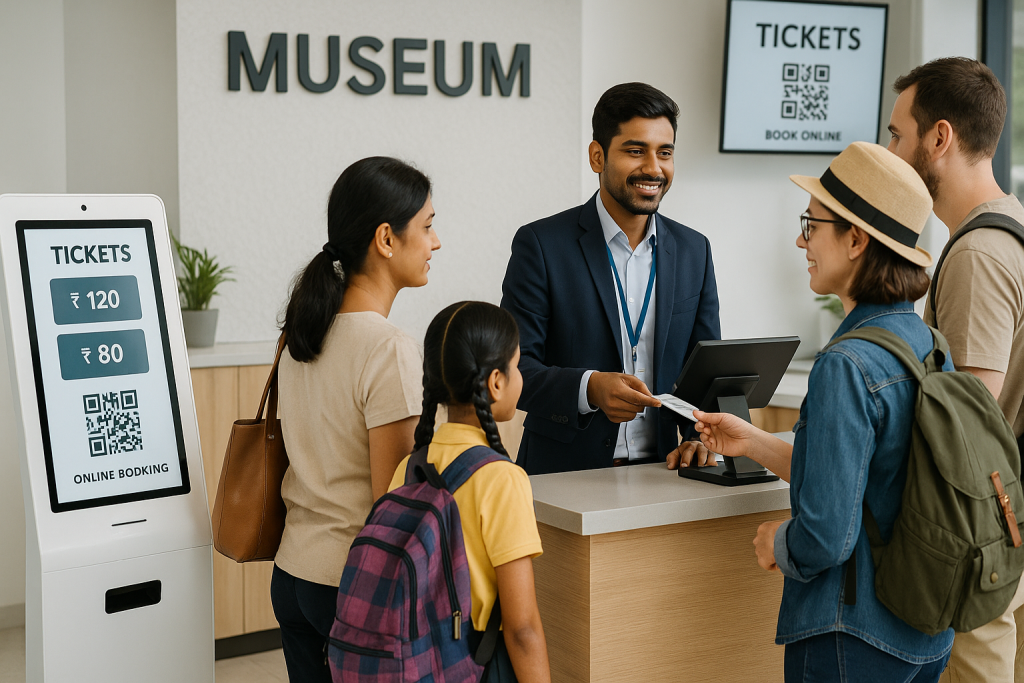
The buyer journey on a museum booking page is short. A visitor selects a date, picks a ticket category, lands on payment, and either pays or leaves. The window from intent to payment is typically under 90 seconds. If UPI is missing, a UPI-first buyer rarely switches to a card. If a card option is missing, a foreign visitor cannot complete the booking from abroad. If wallets are absent, the high-frequency visitor who pays through Paytm or PhonePe wallet credits drops off.
The fix is structural. An online ticketing service needs to present every common rail at the payment step. Not behind a toggle. Not as a future roadmap item. According to NPCI’s published statistics, UPI volumes have continued to grow year on year, which only widens the gap between platforms that support it natively and platforms that bolt it on later.
The Three Payment Rails Every Museum Ticketing System Needs
UPI
UPI now handles the majority of small-ticket consumer payments in India. For museum ticketing software, this means UPI is the default, not a feature, and not an add-on. The checkout must support both intent flow (scan-and-pay or QR) and collect requests. We see UPI as a baseline for any tax-compliant ticketing deployment.
Wallets
Paytm, PhonePe, and Amazon Pay wallets still close a meaningful share of museum ticket purchases. This is especially true for repeat visitors who hold loyalty credits. Any modern online ticketing service should present wallets alongside UPI, not as a fallback. Hiding wallet options behind extra clicks costs the museum conversions with no offsetting benefit.
Cards
Cards matter for three audiences that museums consistently undercount: foreign visitors booking from abroad, corporate group bookings paid on company cards, and premium exhibition tickets where the buyer wants reward points. Domestic credit cards, debit cards, and international cards all need to clear without separate processors.
What Museum Finance Teams Should Audit Before Buying Online Ticket Services
Before signing, the finance head should ask the vendor for clear answers on the points below.
- Settlement timeline: How quickly do UPI, wallet, and card collections settle to the museum account? T+1 is now standard for UPI. Cards may sit at T+2 or T+3.
- Failed-transaction recovery: When a payment fails after debit, who initiates the refund, and how long does it take?
- Reconciliation format: Does the dashboard generate a single settlement file across all three rails, or does the finance team need to merge files from three processors?
- GST treatment: Is the invoice generated at the point of sale with the correct GST split, or is it added later?
- Refund handling: Refunds for cancelled bookings should flow back through the original rail without manual intervention.
I have included a fuller version of this checklist in our procurement guide for Indian museums. It is the same version that finance and procurement teams have used to evaluate vendors over the last 18 months.
How Payment Failures Drain Museum Revenue
The cost of a fragmented payment stack is not abstract. It shows up in three places.
- Direct revenue loss: Every abandoned checkout is a ticket the museum did not sell. At a mid-size museum doing 5,000 online bookings a month, even a 10% drop-off from payment friction is 500 lost tickets. That is roughly ₹1.5 lakh in monthly revenue at average ticket prices.
- Operational drag: When reconciliation requires manually merging UPI, wallet, and card files, the finance team loses hours every week. Multiply across 12 months, and it is the equivalent of a part-time role.
- Audit risk: Government museums operate under tax and audit requirements that are easier to meet when settlement is unified. Fragmented payment data is harder to defend during a tax audit.
The Reserve Bank of India’s press releases continue to flag digital payment failure rates as a measurable consumer friction point. Buyers should treat this as a category-level signal, not a vendor-specific complaint. Museum ticketing software that treats payment coverage as an afterthought ends up exporting that friction directly to the visitor.
Why We Built Our Payment Stack for Indian Museums
We built EveryTicket’s payment stack with UPI, wallet, and card collection under a single checkout, a single settlement file, and a single GST-compliant invoice. The museum finance team sees one reconciliation report at the close of the day. Refunds flow back through the original rail without manual intervention. The platform handles both Indian nationals and foreign visitors at the same checkout, with the correct ticket category and tax treatment applied automatically. Over 150,000 tickets have moved through this stack across our deployments, including MAP Bangalore. We continue to add rails as payment behaviour shifts. To see EveryTicket’s full payment stack in action, request a demo.
Conclusion
Choosing online ticket services in 2026 is no longer a decision about software features in isolation. It is a decision about whether the payment layer matches how your visitors actually pay. UPI, wallets, and cards are not three competing options. Three rails must all be present, settled together, and reconciled in one report. Museum buyers who audit settlement timelines, refund flows, and GST treatment before signing avoid the most expensive mistake in this category. That mistake is picking a platform whose payment stack costs them visitors at the final click. The right museum ticketing software for Indian institutions treats payment coverage as a baseline, not an upgrade, and the right evaluation framework puts the payment audit first.
Frequently Asked Questions
What payment options should online ticket services support for Indian museums?
UPI, mobile wallets like Paytm and PhonePe, and credit and debit cards, including international cards for foreign visitors, should all be supported.
Why is UPI essential for an online ticketing service in India?
UPI is the default consumer payment rail, and missing it pushes most domestic visitors off the museum checkout page within seconds.
How long does payment settlement take in museum ticketing software?
UPI typically settles at T+1, wallets at T+1, and credit and debit cards at T+2 or T+3, depending on the payment processor used.
What should finance teams check about refunds before buying an online ticketing service?
Confirm refunds flow back to the original payment rail automatically without staff intervention and are completed within five to seven working days.
Does EveryTicket support UPI, wallet, and card payments in one checkout?
Yes, we support UPI, all major wallets, and domestic and international cards through one unified checkout and a single settlement report.