Museums running ticketed events alongside regular admissions do not need two separate platforms. A well-configured event ticket sales platform handles both. The real question is whether your current setup is creating reconciliation work that forces your team to manage software instead of serving visitors.
This article gives you a framework to answer that question. I will cover what each type of system is built for, where they overlap in practice, and what the operational cost looks like when museums run them as separate tools.
Key Takeaways
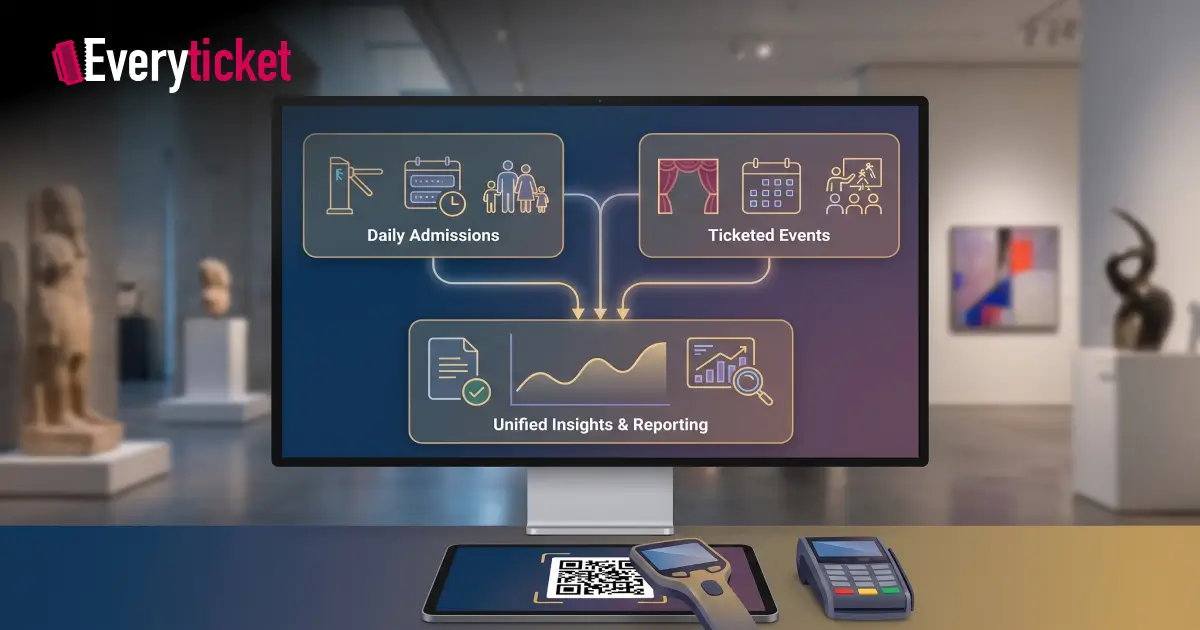
– A unified event ticket sales platform manages daily admissions and ticketed events from one dashboard
– Separate platforms create doubled GST reconciliation work and fragmented visitor data
– Most in-museum events (workshops, lectures, exhibition previews) fall within what museum ticketing software handles natively
– A standalone event ticketing software tool adds value only when event scale genuinely exceeds your core platform
– One system means one UPI settlement, one daily report, and one audit trail
What event ticketing software and museum ticketing software are actually built to do
Event ticketing software and museum ticketing software approach the same problem from different starting points.
Event ticketing software is designed for:
– Time-limited ticket sales with defined open and close windows
– Independent event pages with their own pricing, capacity, and date range
– Online pre-sales with automated QR ticket delivery
– Basic attendee data collection per event
Museum ticketing software is designed for:
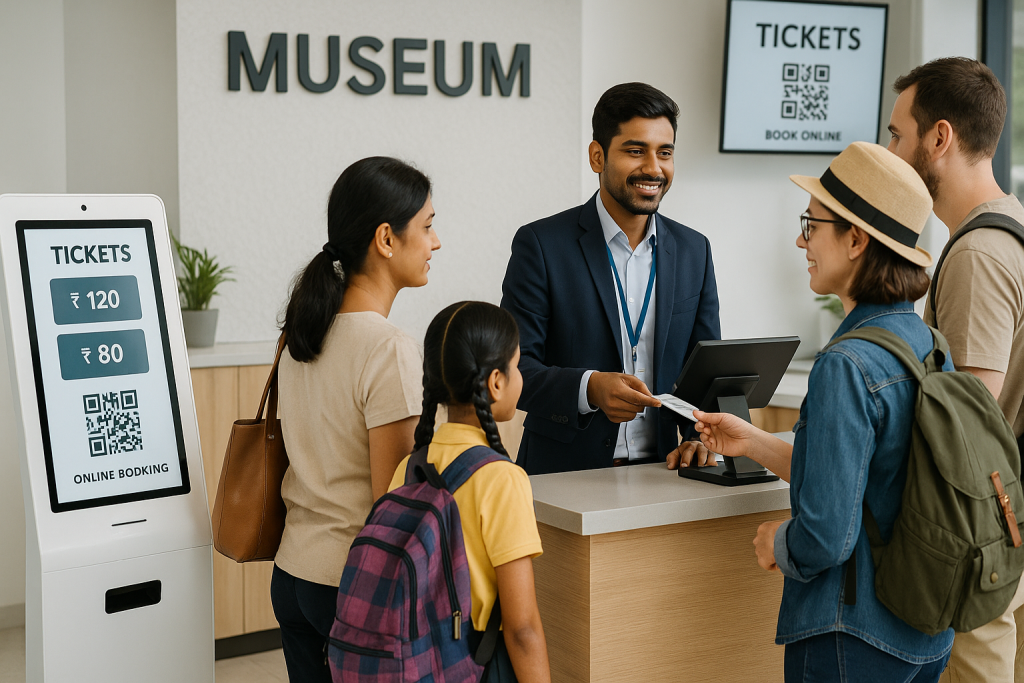
– Recurring daily admissions with timed entry across operating hours
– Multi-category pricing for Indian nationals, foreign nationals, SAARC visitors, and concessions
– Walk-in POS counter operations with offline mode for connectivity gaps
– GST-compliant invoicing and daily settlement reports for finance teams
The functional overlap is substantial. Both require capacity enforcement, QR scanning at entry, payment processing across UPI, card, and cash, and real-time reporting. When a museum adds a ticketed heritage walk or evening lecture, it does not need fundamentally different technology. It needs the same platform configured for an additional event type.
Where museums run into operational trouble
The problem begins when a museum team signs up for a standalone event ticketing software tool to handle a new program, while still running admissions on their existing museum ticketing software.
What accumulates over time:
- Visitors buying an event ticket go through a different booking flow than admission visitors
- The accounts team reconciles two separate sales reports each month
- GST invoicing runs through two systems, creating a gap in the audit trail
- UPI and card settlements arrive from two payment providers on the same day
- Staff check two dashboards to confirm available capacity for the same venue
I have seen this pattern at cultural institutions across the country. The original decision was reasonable. A ticketed photography exhibition needed to go live quickly, and the existing museum ticketing software had no obvious path to configure it. A standalone platform solved the immediate problem. The operational drag built every week it ran alongside the main system.
India’s Ministry of Culture lists hundreds of government-aided museums operating across the country. A large proportion run rotating programs alongside permanent collections. The dual-platform problem is not an edge case for cultural institutions here. It is close to a default.
The hidden cost of running a separate event ticket sales platform
Running a dedicated event ticket sales platform alongside separate museum ticketing software has costs that do not appear in the initial comparison.
Direct costs:
– Monthly subscription fees for a second platform
– Per-ticket commissions from most standalone event ticketing software (typically 2-4% per transaction)
– Duplicate payment gateway fees on the same day’s revenue
Operational costs:
– Manual data reconciliation before monthly GST filings
– Two staff training cycles for every new hire
– No consolidated visitor database, event attendees and regular visitors sit in separate systems
– No ability to cross-reference footfall and event attendance in a single report
For any government institution, the reconciliation burden is significant. Audit requirements expect a consistent picture of all revenue collected. Two systems mean two data sources that a finance officer must merge manually before any audit report can be produced. GST-compliant museum ticketing removes this problem by treating admissions and events as a single revenue stream.
What a unified event ticket sales platform covers for both use cases
Museum ticketing software built with event management as a native feature handles both functions within the same operational environment. Here is what that looks like in practice:
For admissions:
– Timed entry with capacity limits across daily operating hours
– Multi-category pricing for Indian nationals, foreign nationals, and concessions
– Walk-in POS with offline transaction logging and auto-sync when connectivity restores
– QR code generation and entry scanning
For events:
– Separate event pages with independent pricing and date windows
– Online pre-sales with QR delivery in the same format as admission tickets
– Real-time capacity updates shared across online and counter channels
– Per-event financial reporting within the same daily settlement
The settlement report at close of day covers both revenue streams. GST invoicing applies consistently to both. Visitor data from admissions and events lands in the same system.
ICOM’s guidance on museum financial sustainability notes that event programming is a growing share of cultural institution income. Managing that revenue stream through a fragmented toolset reduces the financial visibility institutions need to make sound programming decisions.
When evaluating options, the features to look for in a ticketing platform include this native event management capability, not a bolt-on integration requiring a second login and separate reporting.
When a separate event ticketing tool still makes sense
There are legitimate scenarios where a standalone event ticket sales platform is the right call:
- High-volume public events: A museum hosting a 5,000-person outdoor night festival with external vendors and multiple performance zones needs infrastructure beyond what most museum-specific systems are built for
- External promoters: When an outside organizer manages ticketing for an event held at the museum’s venue independently
- API-connected hybrid: If your existing museum ticketing software has a documented API integration with a specialist event platform, unified data flows are achievable without a full migration
These are exceptions. For the full range of in-museum programming that most cultural institutions run (workshops, lectures, themed tours, members-only previews, exhibition openings), a unified system covers the operational requirements. If your events consistently draw under 500 attendees and are managed by your own team, a second platform adds complexity without adding capability.
The guidance on museum event ticketing software covers the feature set in detail for institutions comparing options across both categories.
How EveryTicket handles both in one dashboard
We designed EveryTicket’s event management module specifically for this operational situation. Museum administrators manage daily admissions and ticketed programs from the same dashboard. Event creation, capacity configuration, online pre-sales, QR scanning, and settlement reports all run within the same system that handles walk-in POS and timed entry.
We have processed over 150,000 tickets across museum deployments that include institutions running rotating exhibitions and regular cultural programs throughout the year. GST-compliant invoicing, UPI payments via Pine Labs and PayU, and audit-ready reports cover both admissions and events without manual reconciliation between systems.
If your team currently manages two platforms, or is evaluating whether to add one, the integrated online ticketing and POS overview shows how both functions operate from a single counter and online flow.
See how EveryTicket handles both. One platform.
FAQs
What is an event ticket sales platform?
A system that manages event registrations, payment processing, capacity limits, and QR ticket delivery for ticketed events.
Can museum ticketing software handle in-museum events?
Yes. Most museum-built platforms support separate event configurations with independent pricing, capacity, and online pre-sale windows alongside regular admissions.
Do cultural institutions need separate event ticketing software for workshops and lectures?
No. In-museum events under 500 attendees fall within the operational scope of a unified museum ticketing platform.
What features should event ticketing software include for cultural venues?
Event-specific capacity limits, independent pricing windows, online pre-sales, QR entry scanning, and GST-compliant invoicing per event.
How does a unified platform simplify GST compliance for cultural institutions?
It consolidates all transaction types into one settlement report, eliminating the need to manually reconcile data across multiple systems.
Conclusion
Most cultural institutions do not need two platforms. A well-built event ticket sales platform designed for museums manages daily admissions and ticketed events in a single system. The operational case for consolidation is clear: one settlement report, one GST audit trail, one staff training cycle, and one visitor database.
Before adding a separate event ticketing software tool, ask whether the events your institution runs genuinely exceed what your museum ticketing software already handles. For the majority of in-museum programming, the answer is no. Running two platforms in parallel creates the reconciliation overhead that teams spend time managing every month, time that produces no value for the institution or the visitor.