Museum directors often search for “free museum ticketing software” when they need to modernize without breaking the budget. You might be looking to move away from spreadsheets, reduce queues at the entrance, or simply sell tickets online for the first time.
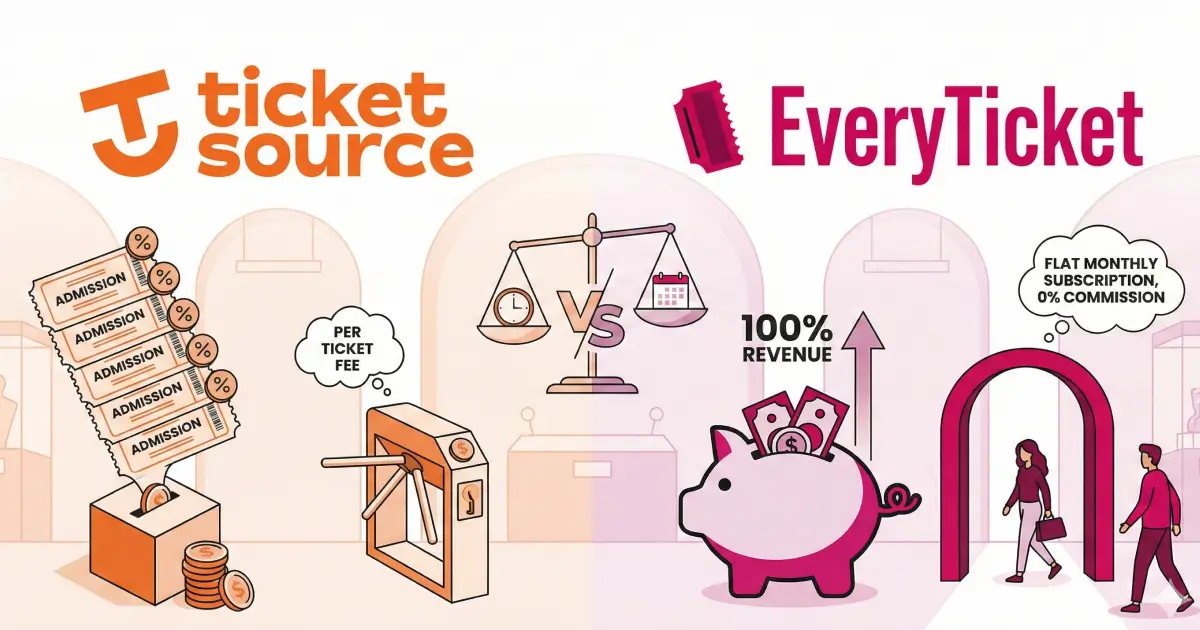
When you compare options like TicketSource and EveryTicket, you quickly realize that “free” can mean two very different things. One model offers no monthly cost but charges a fee on every ticket sold. The other charges a small monthly subscription but allows you to keep 100% of your ticket sales.
This review compares TicketSource and EveryTicket to help you decide which financial model actually saves your museum money in the long run.
The “Free” Model Explained: Monthly Fees vs. Per-Ticket Fees
Most ticketing platforms fall into one of two categories. Understanding this difference is critical for your budget.
1. The “Free to Start” Model (TicketSource)
TicketSource is popular because it has no monthly subscription fee. You can sign up and start selling immediately. If your event is free for visitors, the software is free for you to use. However, for paid events, they charge a booking fee on every single ticket. This fee is either paid by the museum or passed on to the customer.
2. The “Subscription” Model (EveryTicket)
EveryTicket operates on a subscription basis. You pay a flat monthly fee, but you pay 0% commission on your ticket sales. You keep the entire face value of the ticket (minus standard payment gateway charges). For museums selling daily tickets, this model often results in lower total costs compared to paying a commission on every visitor.
Note: If you are strictly looking for a risk-free way to test professional software, EveryTicket offers a 14-Day Free Trial. This allows you to set up your dashboard and test the system without a financial commitment.
TicketSource Review: Best for Occasional Events
TicketSource is a general-purpose ticketing platform used by theaters, schools, and community centers. It is a strong option for museums that only hold occasional paid exhibitions or events rather than daily admissions.
Pros:
- No Upfront Cost: You do not pay anything until you sell a ticket.
- Good for Free Events: If you are running a workshop with zero entry fee, the software is completely free to use.
- Self-Service: The backend is designed for you to set up events quickly without talking to a sales team.
Cons:
- High Scaling Costs: As your visitor numbers grow, the booking fees add up. If you sell 5,000 tickets a year, the booking fees will likely cost significantly more than a flat monthly subscription.
- Generic Interface: The system is built for general events (like plays or gigs), not specifically for museum operations. It lacks features for membership management or daily walk-in visitors.
- Branding Limits: The ticket pages often look like TicketSource pages, rather than your museum’s own branded portal.
EveryTicket Review: Best for Daily Museum Operations
EveryTicket is designed specifically as a museum ticketing system in India. It focuses on the daily needs of running a museum, such as managing walk-ins, school groups, and memberships.
Pros:
- Revenue Protection: Because there is 0% commission, your software costs remain flat even if your ticket sales double. This is crucial for growing museums.
- Dedicated POS (Point of Sale): EveryTicket includes a “Smart Counter” system for your physical ticket desk. This syncs instantly with online sales to prevent overcrowding.
- Custom Branding: Your ticketing page looks exactly like your website, which builds trust with visitors.
- Indian Context: The system supports UPI payments, WhatsApp integration, and GST compliance out of the box.
Cons:
- Monthly Fee: Unlike TicketSource, there is a recurring monthly cost. However, this is usually offset by the savings on booking fees.
According to a report by the Association of Children’s Museums, selecting software flexible enough to meet unique requirements, like membership integration, is often more valuable than simply choosing the cheapest initial option. EveryTicket addresses this by including membership tools directly in the dashboard.
Feature Comparison: Operational Needs
Beyond pricing, the daily functionality of the software matters. Small museums often struggle with “pain points” like long queues or manual data entry.
Queue Management and Timed Entry
TicketSource offers basic time slots, which works for simple entry. EveryTicket provides advanced timed-entry scheduling. You can set strict capacity limits for specific hours to prevent overcrowding in sensitive galleries. This feature directly addresses the need for ticketing software for small museums that have limited space.
For a deeper look at how this works, you can read about features that reduce queues in museum ticketing systems.
Visitor Data and Analytics
TicketSource provides data on who bought tickets, but because it is an aggregator, the data ownership can sometimes feel less direct. EveryTicket prioritizes your ownership of visitor data. You can track peak visiting hours and visitor demographics to make better marketing decisions.
On-Site vs. Online Sales
TicketSource is primarily an online tool. If a visitor walks up to your desk, your staff might still have to issue a paper ticket manually or use a separate system. EveryTicket integrates both. Your staff can print a ticket at the counter that syncs with your online inventory in real-time.
Which “Free” Approach is Right for You?
Choosing between these two depends on your definition of “free” and your operational volume.
Choose TicketSource if:
- You are a volunteer-run museum with no budget.
- You only sell tickets for one or two special events per year.
- You are comfortable passing a booking fee on to your visitors.
Choose EveryTicket if:
- You are open daily and want to keep 100% of your ticket revenue.
- You need a dedicated museum ticketing system in India that handles UPI and local tax laws.
- You want to professionalize your front desk with a POS system.
- You want to avoid the “tax on success” where costs rise as you become more popular.
Research from UNESCO on digital transformation suggests that sustainable funding models, like predictable subscriptions, are often more stable for cultural institutions than variable costs. This aligns with EveryTicket’s flat-fee approach.
If you are unsure about committing to a subscription, remember that you can explore the system first. You can check out how to choose the right museum software to see a detailed checklist of what your institution might need.
Conclusion
Finding the best free museum ticketing software is not just about the upfront price tag. It is about total cost of ownership. TicketSource offers a great entry point for free events or very small museums. However, for institutions looking to grow, the per-ticket fees can become a heavy burden.
EveryTicket offers a solution that protects your revenue. By charging a flat fee and 0% commission, it ensures that the money you earn goes back into your museum, not into software fees.
If you want to see how a dedicated system can streamline your operations and save you money, start your 14-day free trial with EveryTicket today. You can test the full feature set risk-free and decide if a zero-commission model is the right step for your museum.