
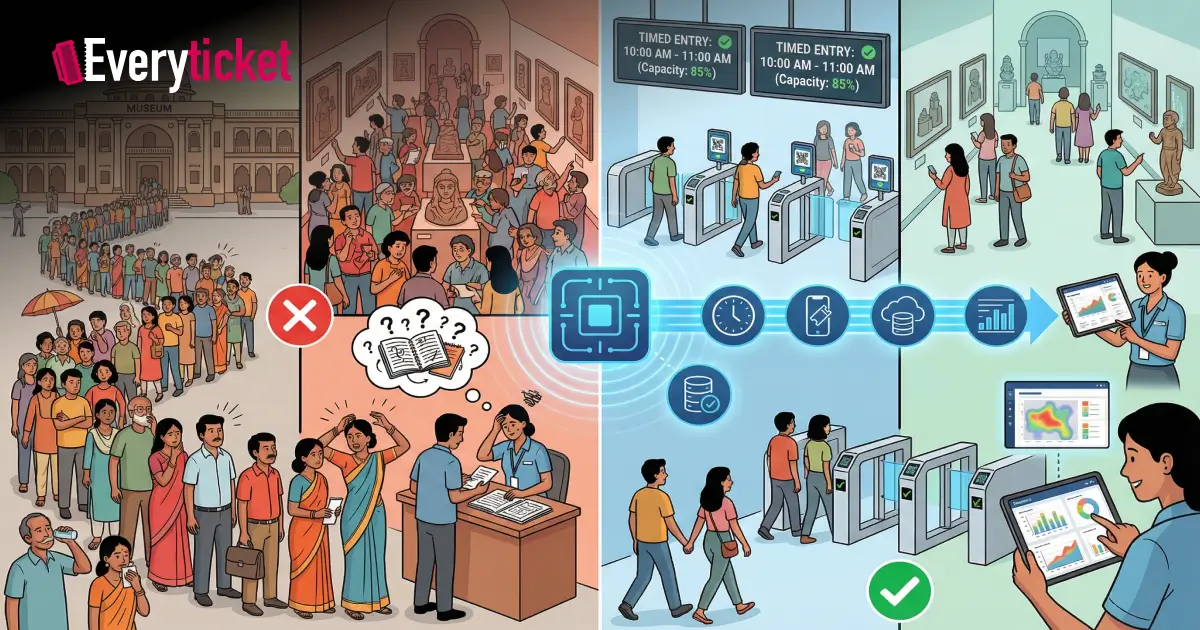
India’s museum footfall exceeded 5.49 crore visitors in 2023–24, a 19% increase in four years, according to Archaeological Survey of India data. Large museums in metro cities now handle thousands of visitors on a single day. Without a structured museum entry management system, that volume produces long queues, overcrowded galleries, and visitor complaints.
This article explains what a museum entry management system does, how each component addresses crowd management in museums, and what large Indian institutions should evaluate before choosing museum ticketing software.
Overcrowding Is No Longer a Seasonal Problem, It Happens Every Week
Peak crowds are no longer limited to national holidays or cultural festivals. They occur every weekend, every time a school group arrives without a pre-assigned slot, and every time walk-in visitors converge at the counter simultaneously.
The operational impact is direct:
- Gallery density exceeds safe capacity, creating discomfort for visitors
- Entry queues form before the museum opens, frustrating visitors before they step inside
- Staff spend time managing queues at counters instead of assisting visitors on the floor
- Manual ticket counting produces errors in footfall records, making planning inaccurate
Museums that rely on paper registers or basic POS terminals have no real-time visibility into how many people are inside. Acting on crowd problems becomes reactive rather than preventive.
What a Museum Entry Management System Actually Covers
A museum entry management system is software that controls visitor access from the point of booking to the point of exit. It connects online museum ticketing, physical entry points, and back-end analytics into one platform.
It is not a ticket counter. A ticket counter processes a payment. A museum entry management system manages the entire visitor flow: before arrival, at entry, inside the museum, and after exit.
Core functions include:
- Timed entry: assigns each visitor a specific time slot with a fixed capacity limit
- QR code check-in: verifies pre-booked tickets at entry without manual counting
- Live footfall tracking: shows real-time visitor counts across galleries and zones
- Group booking management: handles school trips, guided tours, and corporate visits with dedicated slots
- Analytics dashboard: records attendance trends, peak hours, and visitor behaviour data
A visitor management system built for museums consolidates all of these into one operational layer, reducing the number of disconnected tools staff need to manage.
Timed Entry: The Most Reliable Tool for Crowd Control in Museums
Timed entry is the most consistent crowd management method available to large museums. It works by dividing the operating day into fixed slots and setting a visitor limit per slot. When a slot reaches capacity, the online museum ticketing software closes it automatically to new bookings.
Research published by MuseumNext confirms that timed reservation systems reduce overcrowding at high-footfall sites by approximately 15%.
What timed entry achieves:
- Visitor arrivals spread across the day, eliminating morning surges
- Staff know exact visitor numbers per hour in advance, enabling better preparation
- Entry queues shorten because visitors arrive at scheduled times
- Gallery density stays manageable throughout the full operating day
For large Indian museums handling consistent school group volume and weekend crowds, timed entry is a core operational requirement, not an optional feature.
Online Museum Ticketing Moves Crowd Control Upstream
Online museum ticketing gives a museum visibility before the visitor arrives. Once a visitor books a timed slot online, the museum already knows how many people to expect, when they will arrive, and which sessions are filling up.
This advance data enables specific actions:
- Staffing decisions made the day before, based on confirmed booking data
- Automatic alerts when time slots approach capacity limits
- Off-peak slots offered at lower prices to redistribute visitor demand
- School and group bookings confirmed with assigned entry times in advance
India’s digital infrastructure supports online ticketing services for museums directly. With over 750 million smartphone users and UPI as a standard payment method, adoption barriers on the visitor side are low. A visitor who books transport and food online expects the same convenience from a museum.
The difference between counter tickets and online booking is measurable: online bookings reduce walk-in uncertainty and give operations staff reliable visitor data before peak hours begin.
Real-Time Analytics: How Museums Stop Reacting and Start Planning
Museum ticketing software that includes real-time analytics provides a live picture of visitor movement inside the building. This is different from end-of-day reports. Real-time data supports decisions made during the operating day itself.
What Real-Time Data Enables
- Monitoring visitor counts per gallery zone at any moment during operating hours
- Redirecting visitors from dense areas before overcrowding becomes a safety concern
- Adjusting staff positions dynamically based on live footfall figures
- Identifying which exhibits draw the longest dwell times for future layout and scheduling decisions
According to Mapsted, 78% of museum institutions now use analytics for visitor behaviour. Those that do can plan exhibit scheduling, event programming, and staff allocation with far greater accuracy than museums relying on manual records.
Kiosks and POS: Eliminating the Single-Counter Bottleneck
A single ticket counter creates a single point of failure. When it slows down, the entry queue grows.
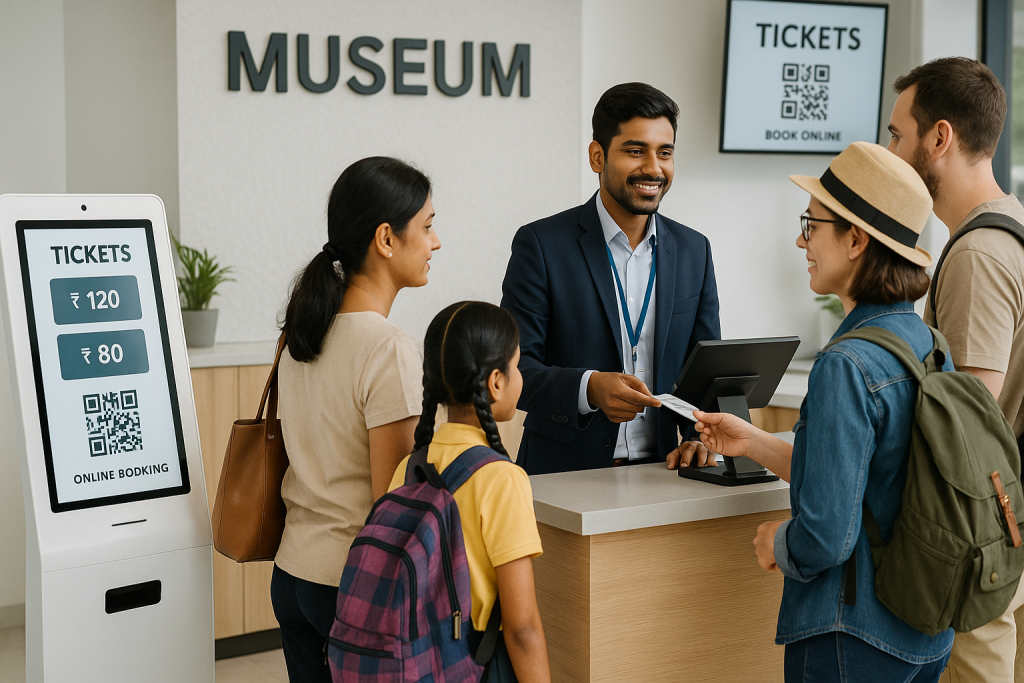
Self-service kiosks work alongside POS terminals to distribute transaction load across multiple entry points. Visitors who pre-booked scan QR codes and enter in seconds. Walk-in visitors complete purchases at a kiosk without waiting for counter staff.
A POS-integrated entry system brings counter, kiosk, and online sales into one consolidated record, improving accuracy in attendance tracking, revenue reporting, and eliminating data gaps between channels.
School Trips and Festival Days: Where Entry Systems Face Their Biggest Test
School trips, heritage walks, and cultural festival days expose weaknesses in any entry system. Museums using an online ticket management system for group bookings gain advance notice of arrival times, group sizes, and slot assignments.
This prevents the common scenario where multiple school buses arrive simultaneously without pre-registration and overwhelm the entry counter. Group-specific time slots, capped per session, distribute that load across the day.
For seasonal events and festivals, entry management software creates dedicated booking flows and per-session attendance caps, so high-volume days remain manageable.
What Large Indian Museums Should Confirm Before Choosing an Entry System
When evaluating museum ticketing software for high visitor volumes, institutions should verify these capabilities:
- Timed entry with configurable capacity per slot and per exhibit zone
- Online museum ticketing with UPI, card, and digital wallet support
- QR-code scanning at all physical entry points, including self-service kiosks
- Real-time visitor count dashboards accessible to operations staff during opening hours
- Group booking management with advance slot assignment for schools and tour operators
- Attendance and revenue analytics for planning, staffing decisions, and board reporting
- GST-compliant invoicing aligned with Indian tax requirements
- CRM integration for membership management and repeat visitor communication
Online ticketing services for museums that cover all of these functions reduce the number of separate tools a museum manages and give leadership a single, unified data source for operational decisions.
EveryTicket: Museum Entry Management Software Built for Indian Institutions
EveryTicket is museum ticketing software designed specifically for Indian museums. It supports timed entry, online museum ticketing, QR-code check-in, self-service kiosks, POS integration, real-time analytics, and CRM, all within one platform.
Museums can activate online ticketing services for museums within 60 minutes of setup. Plans start at ₹3,000 per month with no onboarding charges. Large institutions managing high daily visitor volumes can access the Custom plan with no ticket limits and fully configurable features.
If your museum currently manages entry manually or through disconnected tools, EveryTicket provides the museum entry management system infrastructure to handle that volume accurately and at scale.
Conclusion
High visitor volume is a growth indicator for Indian museums. It reflects genuine public interest in culture, heritage, and education. But volume without a structured museum entry management system becomes a crowd management problem that affects visitor experience, staff performance, and safety compliance.
Online museum ticketing, timed entry, real-time analytics, and integrated POS are the components that convert high footfall into a managed, measurable visitor flow. Large museums that invest in the right museum ticketing software now will build the operational foundation to handle continued growth sustainably.

How Museum Entry Management Systems Are Solving Crowd Control Challenges | Expressy
April 27, 2026[…] To explore how these systems work in detail, you can read:https://everyticket.in/blog/museum-entry-management-system-crowd-control […]
Why Museums Are Finally Fixing Their Crowd Problems - The Viral Blogs
April 27, 2026[…] Want to understand how these systems work in detail?Check out this guide:https://everyticket.in/blog/museum-entry-management-system-crowd-control […]