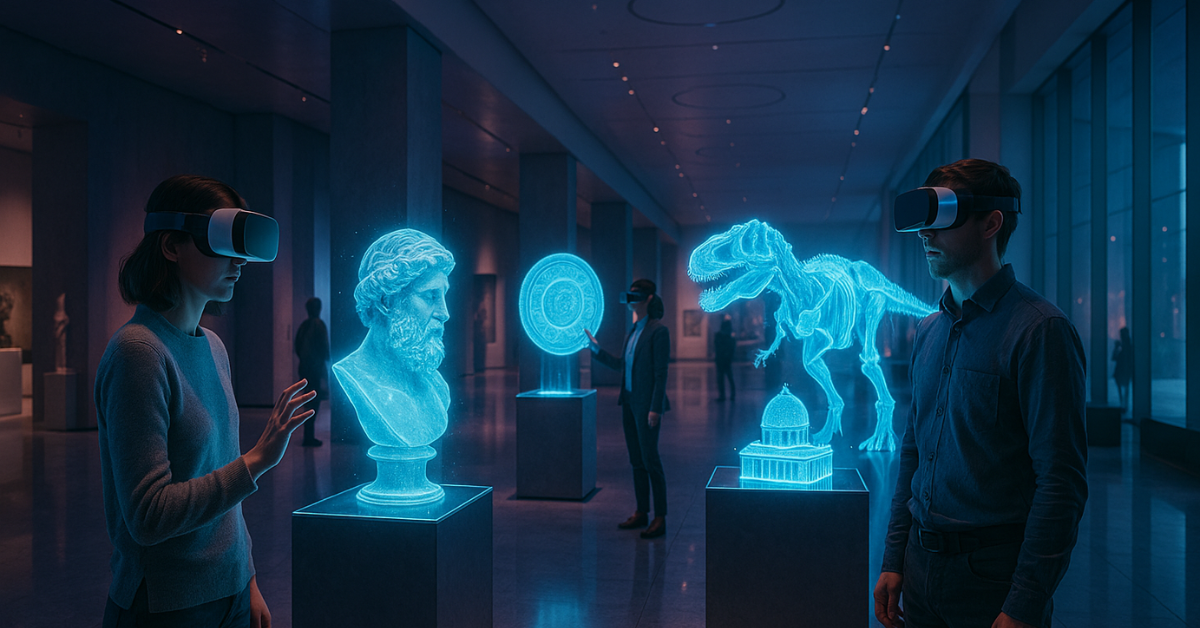
Museums use virtual reality (VR) to create immersive, interactive experiences that attract more visitors and extend the value of traditional exhibits. VR helps museums boost engagement, personalize learning, and generate new revenue streams such as premium VR tickets, merchandise, and virtual tours. By integrating VR with storytelling and education, museums modernize their offerings and compete with digital entertainment alternatives.
Fast Facts
- VR increases visitor engagement by up to 70% in experiential exhibits.
- Museums use VR for historical recreations, artifact simulations, and virtual tours.
- VR introduces new revenue streams: premium tickets, VR rooms, digital memberships, online tours.
- Immersive tech reduces exhibit fatigue, increasing time spent per visitor.
- VR appeals strongly to Gen Z and young families, boosting attendance.
- Museums use VR to make rare, fragile, or lost artifacts accessible.
- Low-cost VR deployments start around $8,000–$20,000.
- Hybrid models combine onsite VR + online VR experiences for global reach.
Walk into a museum and suddenly step inside ancient Rome, dive under the ocean, or stand beside a long-lost artifact — that’s the power of VR fueling the next wave of museum experiences.
Key Concepts Explained
Virtual Reality in Museums — What It Really Means
“Virtual reality in museums” refers to the use of headsets, interactive screens, or projection systems that allow visitors to explore digital environments linked to exhibits. Instead of simply reading plaques, they experience history, art, and science.
Immersive Tech as a Visitor Magnet
Immersive tech like VR, AR, and 360° storytelling transforms passive viewing into active participation.
Examples:
- Walk through a prehistoric forest
- Explore inside an Egyptian pyramid
- Interact with 3D reconstructions of damaged structures
These experiences increase engagement and reduce “museum fatigue.”
Visitor Engagement: Core Revenue Driver
Higher engagement leads to:
- Longer visits
- Higher satisfaction
- Increased repeat footfall
- Better word-of-mouth and reviews
Engaged visitors also buy more tickets, souvenirs, and digital add-ons.
Experiential Learning: Why It Works
VR taps into multi-sensory learning — visual, auditory, and kinesthetic — making educational content more memorable. This is especially effective for school groups and young audiences.
Digital Storytelling & Exhibit Modernization
VR helps museums bring old exhibits back to life. Instead of outdated static displays, VR layers in:
- Animations
- Narration
- Interactive story paths
- Gamified missions
This updates the museum’s identity while preserving its heritage.
Read More: Best Ticketing Platform for New Year Events in India (2026 Guide for Organizers)
Step-by-Step Guide
Step 1: Identify Exhibits That Benefit Most From VR
- Fragile artifacts
- Lost civilizations
- Reconstructed archaeological sites
- Scientific concepts difficult to visualize
Step 2: Choose the Right VR Format
- Room-scale VR: full immersion for premium ticketing
- Portable VR headsets: high throughput for school groups
- 360° domes/projections: group experiences without headsets
- Web-based VR: global reach, new revenue stream
Step 3: Build Content That Aligns With Museum Narratives
- Accurate historical or scientific reconstructions
- Story-rich scenes that complement the exhibit
- Multiple difficulty levels or story paths
Step 4: Launch an Engagement-Driven Experience
- Add narration, guided missions, or collectible “digital badges”
- Integrate gamification to keep visitors curious
- Highlight the VR zone in maps and signage
Step 5: Monetize the VR Exhibit
- Premium ticket add-on (+20–40% revenue)
- Membership tier with unlimited VR access
- Paid virtual field trips for schools
- Branded merch (e.g., postcards from the VR world)
- Online VR tours for tourists who can’t visit
Expert Guide: Best Event Ticketing Solutions for Festivals
Mistakes
- Using VR only as entertainment → Make it educational + story-driven.
- Poor throughput planning → Choose VR formats that allow continuous visitor flow.
- Ignoring accessibility → Offer non-headset versions like projections.
- No clear monetization strategy → Bundle VR with tickets or memberships.
- Untrained staff operating VR → Provide onboarding to avoid technical glitches.
- Not integrating VR with existing exhibits → Make VR a complement, not a standalone gimmick.
- Overly complex content → Keep the experience simple, intuitive, and under 10 minutes.
Myths
- Myth: VR is too expensive for museums.
Truth: Entry-level installations start under $10K with scalable options. - Myth: VR replaces physical exhibits.
Truth: VR enhances, contextualizes, and modernizes them. - Myth: Only tech-savvy visitors enjoy VR.
Truth: Simple guided modes make VR accessible for all ages. - Myth: VR is a fad.
Truth: It’s now a core strategy in museum innovation worldwide.
Examples
Example 1: The Virtual Roman Forum Experience
A mid-sized European museum added a 6-minute VR walk through the ancient Roman Forum.
Results:
- Visitor time increased by 40%
- Premium ticket sales rose by 32%
- School bookings doubled in three months
Example 2: Marine Life VR Dome
A coastal museum launched an underwater VR dome showing 360° coral reefs.
Outcome:
- 60% increase in family visitors
- High social media share rate — free promotion
Example 3: Virtual Field Trips
A history museum created VR field trips for schools unable to travel.
Revenue impact: New online subscription model generating recurring monthly income.
The MUSE-VR Growth Framework™
A simple way for museums to plan successful VR adoption.
M — Map High-Impact Exhibits
Select exhibits with stories VR can enhance.
U — Upgrade Visitor Flow
Design VR setups that avoid queues and congestion.
S — Story-First Experience
Craft narratives that emotionally connect with visitors.
E — Expand Monetization
Add premium pricing, online VR, and merchandise.
VR — Visual Reinforcement
Use VR to amplify learning retention and curiosity.
Why it works:
It blends innovation with museum psychology — ensuring both engagement and revenue grow together.
Most museums think VR is just “cool tech.” In reality, VR is a new business model that transforms:
- How museums attract younger audiences
- How they price experiences
- How they create year-round, global digital access
99% of museums overlook VR as a recurring revenue engine, not just an exhibit add-on.
The true opportunity lies in hybrid VR: onsite experiences + online VR memberships reaching worldwide audiences.
VR Implementation Checklist
- Identify exhibit purpose
- Select VR format
- Storyboarding and scripting
- Accessibility planning
- Staff training
- Monetization decisions
- Soft launch + visitor feedback loop
Tools Museums Can Use
- Unity or Unreal Engine for content
- Insta360 for VR filming
- Meta Quest or Pico headsets
- WebVR platforms for online tours
Comparison: Old Way vs New Way
Old Way
- Static displays
- Long plaques
- Low engagement
- One-time ticket revenue
- Local-only audience
New Way with VR
- Immersive storytelling
- Interactive exploration
- High engagement
- Premium ticketing + digital revenue
- Global access via online VR tours
Wrap-up!
Virtual reality in museums is more than a trend, it’s a powerful tool for boosting visitor engagement, modernizing exhibits, and creating new revenue streams. By blending immersive tech with storytelling, museums can attract younger audiences, increase time spent onsite, and even expand globally through digital VR experiences. With the right strategy, VR becomes a scalable, sustainable growth engine for modern museums.
Want to build a VR experience for your museum?
Book a consultation and get a customized VR roadmap with ticketing solutions.
FAQs
1. Does VR replace traditional museum exhibits?
No, it enhances them by adding depth and interactivity.
2. How much does VR cost for museums?
From $3K to $20K depending on scale.
3. Is VR suitable for children?
Yes, with guided and age-appropriate modes.
4. Can VR increase revenue?
Yes, through premium tickets, online tours, and memberships.
5. How long should a typical VR experience be?
5–10 minutes for best throughput.
6. Do visitors need prior VR experience?
No, simple interfaces make it accessible.
7. What is the biggest benefit of VR in museums?
Significantly higher visitor engagement.
8. Can museums offer VR online?
Yes, a major opportunity for global reach.