Cultural festivals are the highest-footfall events a museum hosts each year. They are also the events where operations break down the fastest. A craft mela during Navratri, a multi-day classical music programme, a heritage week tied to a government initiative, each brings a different crowd pattern, a different booking volume, and a different set of operational demands.
Generic platforms are not built for these scenarios. This article maps real use cases where festival ticketing software resolves specific challenges and shows exactly what ticket automation handles at each stage.
82% of Indian Travellers Now Plan Trips Around Cultural Events, and Museums Are Unprepared for the Volume
According to Skyscanner’s Cultural Tourism Report 2025, 82% of Indian travellers actively plan their journeys around cultural experiences. Millennials (84%) and Gen Z (80%) are leading this shift. Significantly, 76% of Indian travellers have changed their travel plans specifically to attend a cultural event.
This demand is not abstract. It translates to higher footfall during festival periods, larger group bookings, more walk-in arrivals, and faster payment processing requirements.
Museums that rely on manual counters or disconnected booking tools during festivals cannot handle this volume reliably. An event ticket sales platform built for cultural institutions closes the gap between visitor demand and operational capacity.
Use Case 1: Heritage and Folk Art Festivals Bring Unpredictable Walk-In Surges
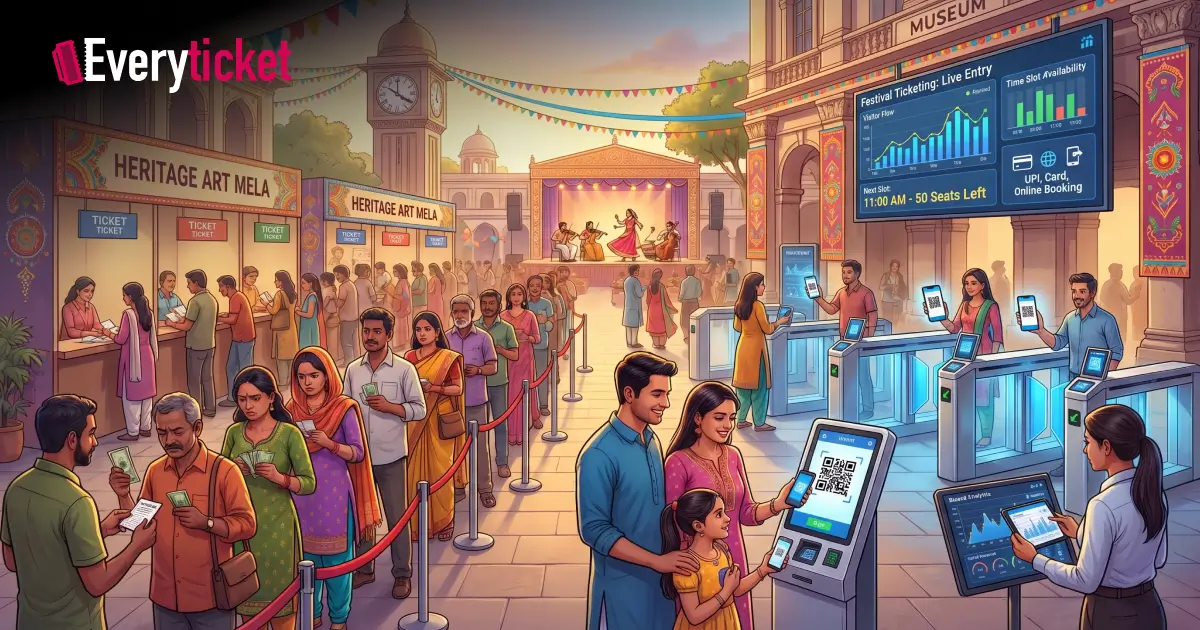
Heritage craft exhibitions, folk art showcases, and cultural melas during Navratri, Dussehra, or regional harvest seasons pull large, unplanned crowds. Visitors do not book in advance. They arrive in clusters, often within a 60 to 90 minute window.
A museum counter that processes 200 entries per hour cannot absorb 800 visitors in that window without failure.
Festival ticketing software handles this by:
- Opening pre-booking with defined entry time slots
- Capping walk-in availability by session so staff can plan around expected volumes
- Processing UPI, RuPay, card, and cash payments at both online and on-site channels simultaneously
- Sending QR code tickets via SMS after booking so visitors arrive with a scannable entry pass
Staff move from managing queues manually to monitoring a live dashboard. Entry verification becomes automated. The counter processes only what the system allows through.
Use Case 2: School and Summer Vacation Season Creates a Group Booking Problem
Summer holidays and school trip season generate the most consistent demand in India’s museum calendar. A single day during peak season can involve 15 to 20 school groups, each ranging from 40 to 60 students, arriving across overlapping windows.
Manual ticketing under these conditions produces delayed entry, duplicate records, and cash handling errors that are difficult to trace.
With advance booking enabled through an event ticket sales platform:
- School groups book separately from individual visitors, each assigned to a dedicated time slot
- Staff see a live headcount dashboard showing group-wise arrival scheduling throughout the day
- On-site kiosks or mobile POS counters handle walk-in payments without disrupting pre-booked group flow
- Group invoices are generated automatically for school administration records
This is one of the highest-frequency failure points for museums during cultural seasons. It is also one of the most directly solvable through ticket automation, with no additional staffing required.
Use Case 3: Multi-Day Cultural Festivals Demand Session-Level Capacity Control
Classical music festivals, dance performance series, and literary events held across multiple days inside museum premises require a structure that single-event tools cannot provide.
Each session has its own capacity, its own audience, and often its own ticket price. A morning raga recital and an evening Bharatanatyam performance are distinct events that may sell out at different rates.
General booking tools treat the entire event as one. Festival ticketing software manages it at the session level:
- Individual session creation with separate capacity limits per performance
- Multiple ticket categories (general, institutional, patron, group, educational) per session
- Dynamic availability updates across online and on-site sales channels in real time
- GST-compliant ticket invoices for each transaction, auto-generated at the point of sale
- Post-event reports segmented by session, ticket type, and payment method
The museum entry management layer connects directly to these session records so staff validate entries against the correct session capacity at the gate.
Use Case 4: Government-Backed Cultural Events Require Compliance-Ready Ticketing Infrastructure
The Ministry of Culture, Government of India, actively funds and runs large-scale cultural events at museum and heritage sites. Its schemes for modernizing and digitizing museums include direct support for improving visitor experience and operational infrastructure.
Regional museums hosting birth anniversary commemorations, heritage week programmes, and UNESCO milestone events under government initiatives face administrative requirements beyond just crowd management. Finance teams and museum boards need accurate, audit-ready records.
Festival ticketing software produces this automatically:
- Visitor count reports segmented by date, ticket category, age group, and nationality
- GST-compliant sales records exportable for government submissions
- Separate ticket tiers for VIP, institutional, and public access managed from one dashboard
- Entry access logs with timestamps, available on demand without manual compilation
Staff do not build these reports at the end of the event. The system generates them as a by-product of each ticket transaction throughout the festival.
What an Event Ticket Sales Platform Actually Automates Across All These Use Cases
The use cases above are different in scale and structure but share the same operational bottlenecks. Across all of them, festival ticketing software automates three distinct phases.
Before the festival:
- Online ticket sales go live across the museum website with time slot selection
- Visitor confirmations and reminders are sent automatically via SMS or email
- Staff receive capacity forecasts per slot based on bookings received
On the day:
- QR code scanning replaces manual entry verification at all entry points
- Staff access a live dashboard showing current occupancy, remaining capacity per slot, and payment breakdowns
- Walk-in payments are processed via UPI or card at the counter or kiosk with no separate reconciliation step
After the festival:
- GST-compliant sales reports, attendance records, and visitor data are available immediately
- Visitor contact information is stored securely for future communication
- Analytics on peak entry times, popular sessions, and cancellation rates inform planning for the next event
This is what makes digital ticketing different from simply moving a counter process online. The automation covers the full operational cycle, not just the point of purchase.
The Revenue Museums Miss Without an Event Ticket Sales Platform
Cultural tourism is a measurable growth sector. India received over 9.66 million international visitors in 2024, with 4.33 million citing cultural and heritage experiences as their primary reason to visit. Domestic cultural travel is growing faster.
Museums that manage festivals manually cannot convert this demand into reliable revenue. An event ticket sales platform adds:
- Advance revenue from pre-bookings, received before the festival date
- Upsell opportunities at checkout, including guided tours, catalogue access, and membership sign-ups
- Dynamic pricing capability to charge differentiated rates for peak sessions and off-peak windows
- Repeat visitor data that enables targeted communication for future events
The revenue impact of structured ticketing compounds across festival seasons. Museums that sell in advance, sell more, and retain visitor data for follow-up, consistently outperform those that rely on walk-in volumes alone.
EveryTicket Is Built for Exactly These Festival Scenarios
EveryTicket is purpose-built for museums and cultural institutions. The platform covers every operational requirement described in the use cases above.
Through its solutions suite, museums can:
- Set up time-slot-based online booking with custom capacity limits per slot
- Run group and institutional bookings separately from individual visitor flows
- Issue QR code tickets instantly via SMS after payment, with automatic entry validation at the gate
- Accept UPI, RuPay, card, and cash through a unified POS and online system
- Generate GST-compliant sales records and attendance reports from one dashboard
The Museum of Art and Photography in Bengaluru uses EveryTicket to manage high-demand cultural events. After implementation, the museum recorded a 40% increase in ticket sales and a 30% reduction in wait times through automated check-in.
For museums planning an upcoming cultural festival, EveryTicket can be configured and operational within 60 minutes. Contact the team to understand how the platform fits your specific event structure.
Conclusion
Cultural festivals represent the largest visitor opportunity a museum has each year. They also carry the highest operational risk when the ticketing infrastructure is not ready for the volume.
Festival ticketing software removes the manual dependency from entry management, payment processing, and post-event reporting. An event ticket sales platform gives museum teams control over crowd flow before the festival begins, not after problems appear on the day.
Museums that automate their festival operations run better events, generate more predictable revenue, and build the visitor data needed to grow attendance year over year.
FAQs
What is festival ticketing software for museums?
It is a digital platform that manages ticket sales, crowd flow, and entry automation during high-attendance cultural festival events.
How does ticket automation reduce festival crowd chaos at museums?
Automation distributes visitors through pre-booked time slots, eliminating walk-in surges and manual queue bottlenecks at entry.
Can an event ticket sales platform handle multi-day cultural festival bookings?
Yes. Modern platforms support multi-day event schedules with individual session capacities and separate slot management per day.
Does festival ticketing software support UPI payments for museum visitors?
Purpose-built platforms integrate UPI, RuPay, and digital wallets to match the dominant payment preferences of visitors.
How quickly can a museum launch a festival ticketing system before a cultural event?
Platforms like EveryTicket enable museums to go live with full festival ticketing operations in under sixty minutes.