Every busy Saturday at a popular heritage museum in India, the story is the same. Visitors stand in lines that stretch beyond the gate. Staff manually issue paper tickets and count cash. Entry slows to a crawl. By the time a visitor reaches the exhibit hall, the experience is already compromised.
This is not a visitor volume problem. It is a process problem. Museum ticketing software replaces slow, disconnected manual steps with a single digital platform that manages ticket sales, entry validation, and visitor data in one place.
India’s Museums Are Sitting at the Centre of a Tourism Boom
India’s domestic tourism reached 2,948 million visits in 2024, a 17.5% year-on-year growth. International tourist arrivals reached 9.66 million in the same period. Museums and heritage sites are direct recipients of this traffic.
The Archaeological Survey of India responded by enabling online ticket booking for over 170 centrally protected monuments and museums through the Open Network for Digital Commerce (ONDC) in January 2026. This move signals where India’s cultural infrastructure is heading. Digital ticketing for museums is becoming the baseline expectation, not an optional upgrade.
Private museums and galleries face the same visitor pressure but must build their own digital infrastructure. That decision directly affects how smoothly their entry operations run.
What Museum Ticketing Software Actually Does
Museum ticketing software is not just an online booking tool. It is a connected operations platform. It links every part of the visitor entry process into one system.
The core functions include:
- Online advance ticket booking with time slot selection
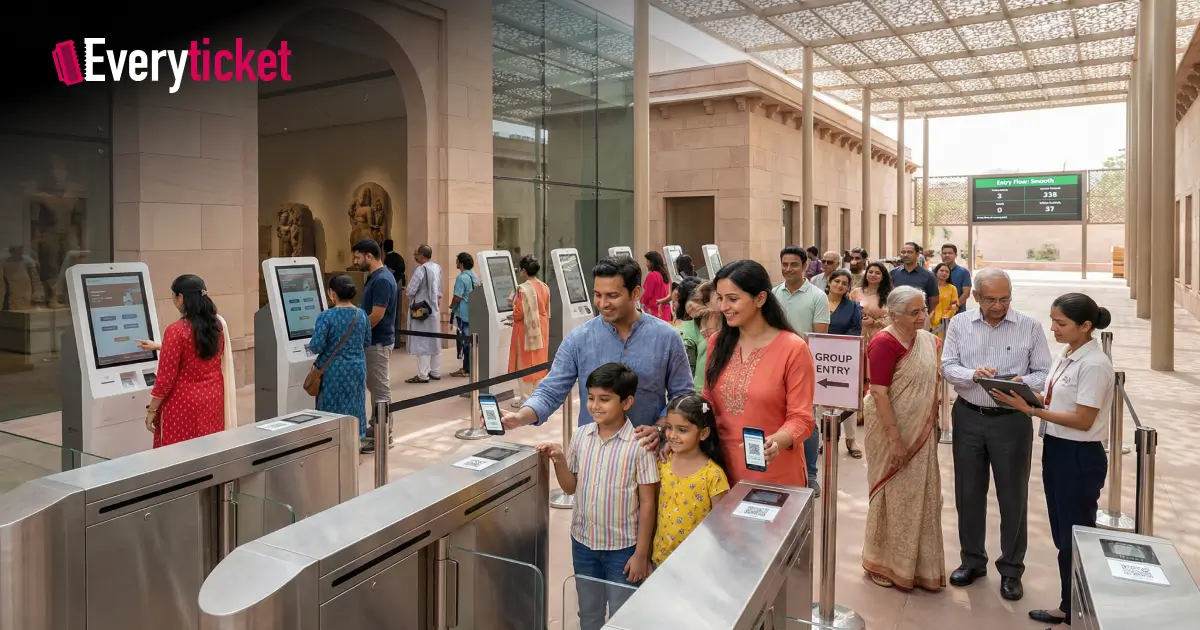
- QR code generation and real-time scanning at entry gates
- On-site POS counter sales with digital payment processing
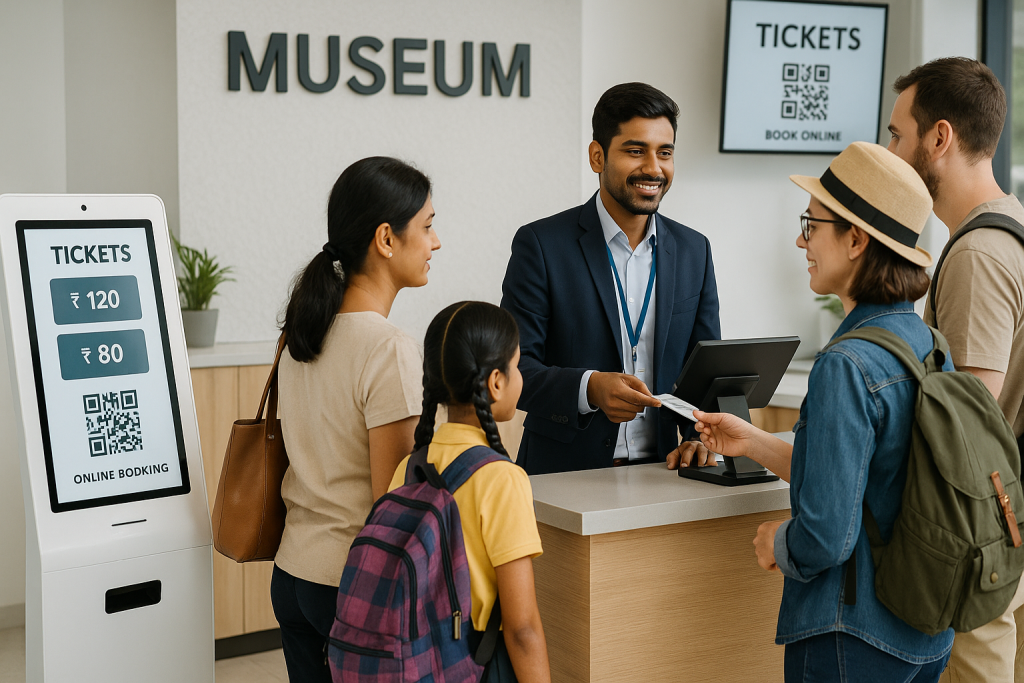
- Self-service kiosk support for walk-in visitors
- Live dashboards showing footfall, capacity, and revenue
- CRM tools for membership and repeat visitor management
- GST-compliant receipt generation on every transaction
When all of these run from one dashboard, staff no longer maintain parallel systems. Data is accurate. Reports are automatic. Entry is fast.
The Queue Is a Symptom. These Are the Real Problems.
Long lines at museum entry gates are the visible result of deeper operational failures. Museum ticketing software addresses each one directly.
Walk-In Visitors Overwhelming the Counter
When the majority of tickets are sold on arrival, the counter becomes a bottleneck. Digital ticketing for museums introduces advance booking with timed entry slots. Visitor arrivals spread across the day. Peak crowding at the gate reduces significantly.
QR Codes That Go Nowhere
Many museums offer online booking, but validate tickets manually at entry because their booking system is not connected to the gate. An integrated entry management system scans QR codes in real time, verifies ticket validity, and records each entry automatically. No manual cross-checking.
Counters Slowing Down During Group Visits
School groups and tour bookings cause the longest delays when handled through standard counters. A connected POS system handles group entries with bulk validation and logs all transactions centrally. Staff do not need to manage group paperwork separately.
Walk-In Traffic Backing Up the Queue
Self-service kiosks handle walk-in ticket purchases without staff involvement. Museum kiosks process transactions in seconds and sync automatically with the central system. Counter staff are freed to assist visitors who need direct help.
No Visibility into What Is Happening at Entry
Without live data, operations teams cannot respond to crowding in real time. A visitor management system shows entry counts by gallery, highlights capacity thresholds, and lets managers deploy staff where needed before congestion builds.
Why Online and Counter Sales Must Work Together
The biggest operational gap in most Indian museums is the separation between online bookings and on-site sales. The two systems do not talk to each other. Staff reconciles figures manually at closing time.
An integrated ticketing platform records both channels in one database. Every transaction, whether booked on a mobile phone at 9 AM or purchased at the counter at 2 PM, appears in the same report. Cash discrepancies drop. Shift reconciliation takes minutes, not hours.
Museums that have made this shift away from traditional counters report measurable reductions in staff hours spent on administrative tasks each day.
What Indian Museums Need That Many Platforms Skip
Global museum ticketing software platforms are often built for European or North American conditions. Indian museum operations teams must verify four things before selecting any platform.
UPI payment support built in: UPI is the dominant payment method for Indian visitors. A platform that routes UPI through a third-party plugin creates delays and failed transactions at payment.
Automatic GST compliance: The system must generate tax-compliant receipts on every transaction without manual input. This applies to both online and counter sales.
Offline transaction recording: Internet connectivity in some museum locations is unreliable. The platform must record sales offline and sync when connectivity returns.
India-based support: Staff training and technical help must be available locally. International support teams operating in different time zones add delays during high-footfall periods.
The International Council of Museums has identified digital tools as essential for museums managing growing visitor volumes and expanding their cultural reach. An India-built platform that handles local compliance removes these friction points from day one.
EveryTicket: Built for Indian Museum Operations
EveryTicket is museum ticketing software developed specifically for Indian museums. The platform covers online booking, QR-based entry management, POS counter integration, self-service kiosks, visitor analytics, CRM tools, and GST-compliant reporting, all from one dashboard.
UPI, cards, and net banking are supported natively. No third-party plugins required. Pricing starts at Rs 3,000 per month with staff training included at no extra cost. Museums go live within 60 minutes of setup.
The platform has processed over 115,000 tickets, including for the Museum of Art and Photography in Bengaluru. Operations teams evaluating their ticketing system options can book a free demo to see the full platform in a live museum environment.
Schedule a free demo with EveryTicket
Digital Ticketing for Museums Is Now an Operational Baseline
The case for museum ticketing software is straightforward. Indian museums are receiving record visitor numbers. Visitors arrive expecting digital payment options, advance booking, and fast entry. Paper-based systems and disconnected tools cannot meet these expectations reliably.
Digital ticketing for museums reduces wait times at entry, eliminates manual reconciliation, and gives operations teams live control over visitor flow. The result is a measurably better experience for visitors and a lower administrative load for staff. The process change is direct. The operational impact is immediate.
FAQs
What is museum ticketing software?
Museum ticketing software automates ticket sales, entry management, and visitor data from one centralized digital platform.
How does digital ticketing reduce queues at museums?
Timed entry slots and QR code scanning eliminate walk-in bottlenecks and distribute visitor arrivals evenly throughout the day.
What features should museum operations teams look for in ticketing software?
Key features include online booking, QR entry, POS integration, self-service kiosks, live analytics, and UPI payment support.
Is museum ticketing software suitable for small museums in India?
Yes. Scalable plans starting from Rs 3,000 per month at EveryTicket, making it accessible for small and mid-size Indian museums.
Does museum ticketing software support GST and UPI payments in India?
Modern platforms generate GST-compliant receipts automatically and natively accept UPI, cards, and net banking transactions.