India’s domestic tourist visits crossed 2.51 billion in 2023. That volume is arriving at museum gates faster than manual systems can process. Procurement heads at Indian museums are now comparing vendors and finalising decisions on museum ticketing service software under real budget and timeline pressure.
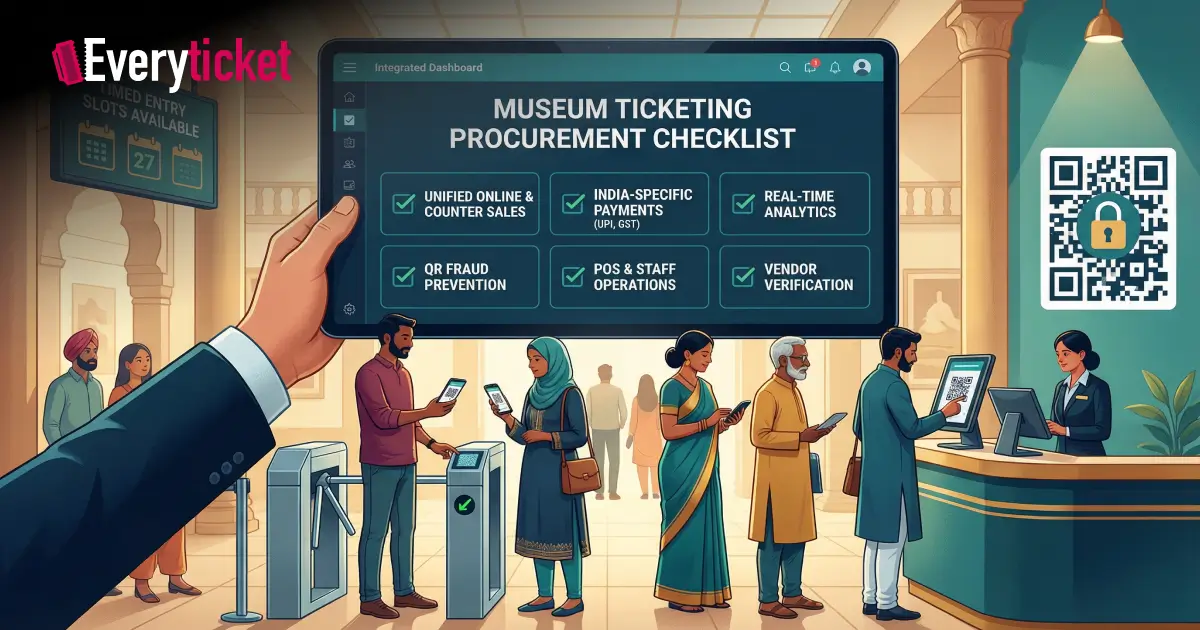
This checklist covers what to verify across six functional areas before committing to any platform. Indian museums evaluating online ticketing services for museums need clear criteria that address both India-specific compliance and core operational requirements. Each item addresses a specific requirement that separates a reliable online ticketing software from one that creates operational problems after deployment.
Separate Online and Counter Sales Systems Are Costing Your Museum Data
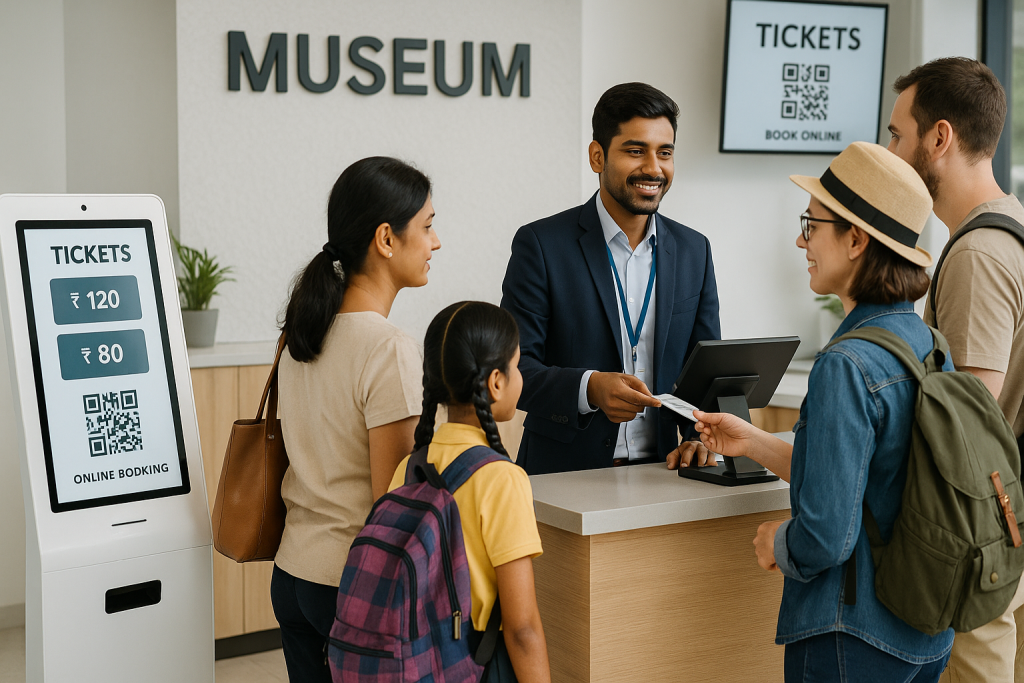
Separate systems for online and counter sales create data gaps, split revenue reporting, and reconciliation errors at the end of every business day. The right museum ticketing software handles both channels on a single dashboard.
Verify the platform includes:
- Online booking portal accessible on desktop and mobile
- Counter (POS) ticketing managed from the same admin panel
- Timed-entry slot controls with real-time capacity limits
- QR code-based digital tickets delivered by email or SMS
- Live ticket availability visible to both staff and visitors simultaneously
The reservation system must let admins set maximum capacity per time slot and block further bookings automatically when the slot is full. For a detailed breakdown of how advance booking controls walk-in rush at Indian museums, the reservation system guide covers the operational mechanics in full.
Evaluating online ticketing solutions on portal design alone misses the most critical integration point: whether the counter and online channels share a single inventory record in real time.
India-Specific Payment Support Is a Legal and Operational Necessity
India’s digital payment infrastructure is mature. Visitors expect UPI at every purchase point. Any online ticketing solutions shortlisted for the Indian museum procurement must reflect the full payment options.
Payment methods the platform must support:
- UPI (PhonePe, Google Pay, Paytm, BHIM, and bank-native apps)
- Net banking
- Debit and credit cards (Visa, Mastercard, RuPay)
- Cash at the POS counter
- Foreign currency cards for international visitors
GST-compliant invoicing is a legal requirement. The platform must generate tax-compliant invoices automatically for every transaction, both online and at the counter. Ask vendors what invoice formats the system produces and whether audit-ready reports are downloadable without manual data extraction.
A museum that processes high volumes of digital payments without GST-compliant invoicing creates compliance liability. Clarify this during the vendor evaluation meeting, not after onboarding.
Your Museum Ticketing Software Has a Counter Problem You Need to Audit
Most procurement evaluations spend evaluation time reviewing the visitor-facing booking portal. Counter-side and staff operations features deserve equal scrutiny. Museum ticketing software that works well for visitors but creates bottlenecks for staff delivers a poor return on investment.
Verify the following for counter and staff operations:
- POS interface that staff can operate without extended training
- Self-service kiosk option to reduce counter dependency during peak hours
- Role-based access controls matched to staff responsibilities
- Group booking management for school visits and institutional parties
- Offline mode capability for periods of connectivity loss
The integration between POS counters and online ticket sales determines whether your staff work from one source of truth or from conflicting records throughout the day. Online ticketing solutions that exclude a functional POS component force museums to manage two separate systems indefinitely.
Museums that host special exhibitions or seasonal programming need an additional layer of ticket management. Exhibition ticketing controls are worth evaluating as a separate line item if your museum runs more than four paid events annually.
Without Real-Time Data, Your Museum Is Planning in the Dark
The American Alliance of Museums identifies data-driven operations as a core practice for financially sustainable cultural institutions. The online ticketing service your museum selects must provide access to operational data, not only transaction records.
Verify the platform includes:
- Real-time dashboard showing visitor count and revenue by channel
- Downloadable daily, weekly, and monthly reports
- Peak hour and footfall pattern analysis
- Visitor category breakdown (domestic, foreign, concession, group)
- Audit-ready financial summaries for management review
Visitor analytics and reporting capabilities vary significantly across platforms. Request a live demonstration of the analytics dashboard separately from the booking interface during vendor evaluation.
Staff planning, pricing decisions, and programming schedules all depend on accurate footfall data. A platform that cannot produce this data reliably reduces management decisions to guesswork.
Counterfeit Tickets Cost Indian Museums More Than Money
Counterfeit paper tickets are a documented problem at Indian heritage sites and busy museums. Online ticketing services for museums must include technical controls that eliminate this risk at the point of entry, not mitigation steps that depend on staff judgment.
Verify the platform provides:
- Unique, non-duplicable QR codes per ticket
- Scan-and-invalidate logic that blocks reuse of any scanned ticket
- Real-time entry scan logs visible to supervisors in the admin panel
- Automatic rejection of tickets already recorded as scanned
How a digital ticketing system blocks counterfeit entry at Indian museums is a procurement question with a technical answer. Ask vendors to demonstrate the anti-duplication mechanism in a live scenario before finalising your shortlist.
Six Questions Every Vendor Must Answer Before Making Your Shortlist
Platform features matter. Vendor delivery capability in India matters equally. These six questions belong in every evaluation meeting.
Pricing model: Subscription-based pricing gives budget predictability. Commission-per-ticket models increase costs during high-footfall periods. Confirm which model applies and what total annual cost looks like at your expected visitor volume.
Onboarding timeline: How long does full deployment take from contract to live ticket sales? Confirm what is included: hardware setup, data migration, and staff training.
Hardware compatibility: Does the platform support existing scanners and printers, or does it require proprietary hardware procurement?
Support availability: Is technical support available during Indian business hours? Is there a dedicated point of contact or only a general helpdesk ticket system?
Scalability: Can the platform handle visitor spikes on national holidays or during promotional campaigns without downtime?
Multi-location management: If your institution manages more than one site, verify that centralised control across locations is available under one account without separate licensing or separate dashboards. Most online ticketing services for museums do not support multi-location natively without a custom build or a higher tier plan.
EveryTicket Addresses Every Requirement on This Checklist
EveryTicket is purpose-built as an online ticketing service for Indian museums. The platform manages online bookings and counter sales on one dashboard. It supports UPI, net banking, debit and credit cards, cash at the POS counter, and foreign cards for international visitors.
GST-compliant invoices generate automatically for every transaction. The platform includes POS integration, self-service kiosks, timed-entry slot management, role-based staff access, real-time analytics, and QR-based fraud prevention.
Subscription plans start at Rs. 3,000 per month. Staff training is included. Onboarding charges are waived. The platform goes live in 60 minutes from setup.
Procurement heads can schedule a live demo to verify how the platform maps to each item on this checklist in a real environment, with your museum’s ticket categories and visitor volumes.
The Right Vendor Is the One That Passes Every Item, Not Just Most of Them
India’s online event ticketing market reached $3.6 billion in 2025 and is projected to grow at 8.62% CAGR through 2034, according to IMARC Group. Museums that delay selecting a capable online ticketing service miss revenue and operational efficiency during the strongest growth period in Indian tourism history.
Use this checklist to evaluate every vendor on your shortlist. The online ticketing solutions that cover India-specific payments, unified channel management, fraud prevention, real-time analytics, and GST compliance are limited. The online ticketing services for museums that combine all of the above with transparent subscription pricing and proven deployment in India are fewer still. Verify every item, request a live demonstration, and make the decision based on evidence.