Large museums in India are managing footfall numbers that their existing infrastructure was never designed for. India recorded over 2.51 billion domestic tourist visits in 2023. The National Museum of India in New Delhi handles 2,500 to 3,000 visitors every single day. When that volume concentrates in a two-to-three-hour morning window, no number of additional staff resolves the problem at the gate.
The challenge at large, high-traffic museums is a scale problem. Visitor congestion does not just mean long queues. It means safety risks, degraded exhibit experiences, exhausted staff, and revenue loss when visitors turn away rather than wait. An online ticketing system addresses this structurally, before visitors ever arrive.
When Thousands Show Up at Once: The Congestion Reality Large Museums Cannot Ignore
High-traffic museums deal with predictable demand spikes that become unmanageable without the right system. The problem consistently appears in three ways:
- Entry bottlenecks: When most visitors arrive in the first two hours of opening, entry gates cannot process the volume fast enough.
- Exhibit crowding: Popular galleries fill beyond comfortable capacity. Visitors cannot engage with the displays properly.
- Staff overload: Museum teams get pulled from visitor engagement to queue management, leaving exhibits unsupported.
Research on visitor flow management at the Uffizi Gallery confirms that the effective fix is a predictive ticketing model controlling how many visitors enter in each time window. The Archaeological Survey of India has already enabled online booking for over 170 monuments and museums through ONDC, recognising that walk-in-only systems cannot sustain current visitor volumes.
The Revenue Damage That Congestion Quietly Causes
Visitor congestion is an operational problem. It is also a financial one. The two cannot be separated at large institutions.
- Museum staff lose an estimated 5 hours daily to manual ticketing and cash reconciliation instead of visitor support.
- Walk-in or partially digital systems generate no data on peak hours, popular time slots, or no-show rates. Without that data, large museums cannot plan staffing or pricing intelligently.
- Online transactions generate 23% higher per-visitor revenue on average compared to walk-up sales, according to museum ticketing market research.
For large museums with significant daily footfall, these gaps translate to substantial revenue loss every month.
How an Online Ticketing System Distributes Visitor Load Before the Gate
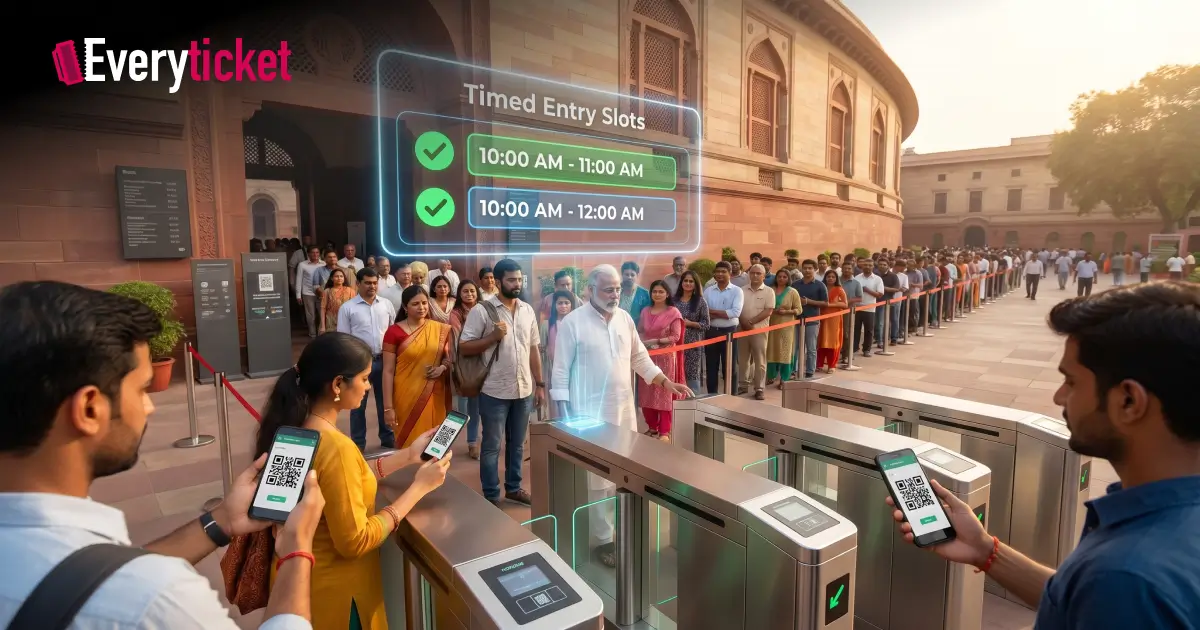
The primary function of an online ticketing system for high-traffic museums is demand distribution. Visitors select a time slot when booking. The system automatically stops selling tickets for that slot once it reaches capacity. Arrivals spread across operating hours rather than concentrating at peak windows.
Global institutions, including the Vatican Museums and the Uffizi Gallery, now require pre-booked timed entry because walk-in volumes exceeded safe capacity limits. Trials of reservation systems at high-footfall cultural sites have demonstrated a 15% reduction in overcrowding, producing measurably better visitor experiences without any physical expansion.
For large Indian museums, an online ticketing system with time-slot management produces three measurable outcomes:
- Visitor arrivals distribute evenly across the full operating day
- Entry processing per visitor drops from three to five minutes to under sixty seconds with QR scanning
- Operations managers receive live headcount data to redeploy staff in real time
Research by the Association of Science-Technology Centers found that structured timed entry increased visitor satisfaction by 25%, because reduced crowding allowed visitors to properly engage with exhibits. That result comes from ticketing infrastructure, not additional physical capacity.
What Ticket Automation Does at Large-Museum Scale
Manual ticketing at large museums creates compounding inefficiencies under high footfall. An online ticket management system replaces those processes with automation across every stage.
Advance Bookings Connect Directly to Entry Gates
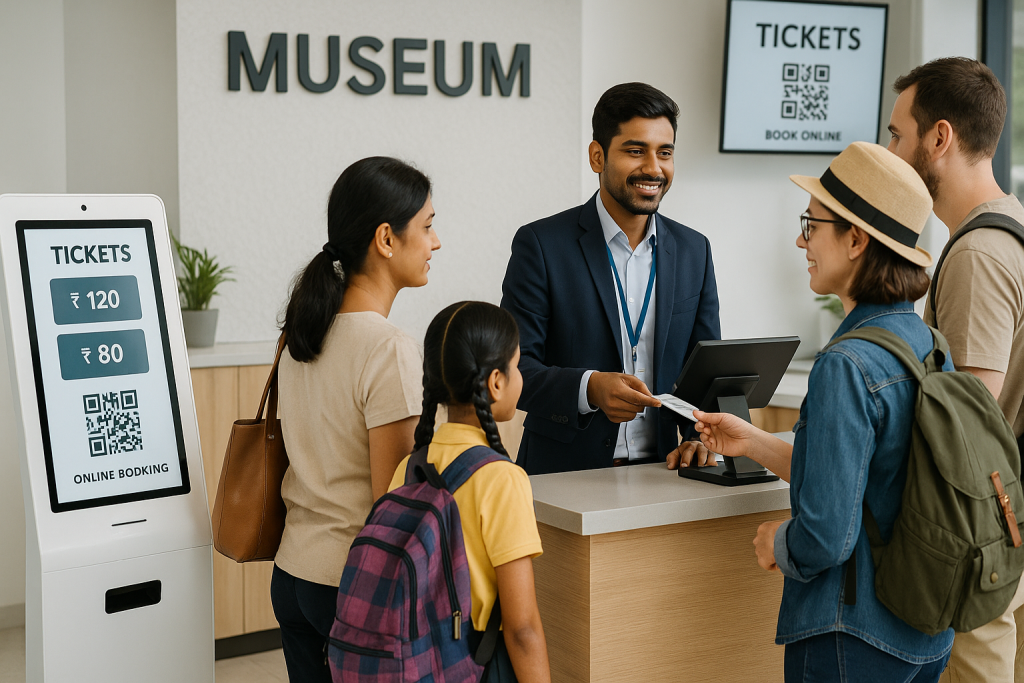
Visitors who book online arrive with a QR code. Entry validation takes under five seconds. No manual list-checking or paper ticket inspection. This is how a museum entry management system handles simultaneous online and walk-in streams without creating counter congestion.
Capacity Limits Manage Themselves
When a time slot fills, the system closes it and redirects visitors to available windows. No staff intervention needed. This prevents surge arrivals from overwhelming entrances during school trips, public holidays, and exhibition openings.
Real-Time Analytics Replace Operational Guesswork
An online ticket management system logs every entry and time slot in a central dashboard. Operations managers see live headcounts, identify galleries approaching capacity, and redeploy floor staff before a bottleneck forms. For museums managing multiple locations, this centralised model is essential for distributing visitor volume intelligently across campuses.
Group Bookings Process Without Counter Delays
School groups and tour operators book in advance with a consolidated entry code. A group of fifty visitors scans through in under two minutes. Without this, every individual goes through manual processing that backs up the entire queue.
What Large Museums Must Require in an Online Ticketing System
Not every online ticketing system is built for high-volume cultural institutions. These are the non-negotiable capabilities:
- Timed entry with automatic slot closure: Capacity caps enforce without manual staff intervention
- Real-time capacity dashboard: Live headcount visible across all entry points simultaneously
- Multi-channel sync: Online bookings, walk-in POS, and kiosk transactions update a single inventory in real time. This is what a complete online ticket management system provides.
- UPI and multi-payment support: Required for India’s digital payment environment
- GST-compliant reporting: Automated tax reporting and clean audit trails for large institutions
- Group booking management: Bulk entry processing that avoids counter backlogs
- Offline capability: Entry validation continues during connectivity drops
Museums assessing platforms should evaluate features built for Indian museum operations against their actual scale requirements.
India’s Museum Infrastructure Push Makes This the Right Moment
The Ministry of Culture’s Museum Grant Scheme provides financial assistance for digital infrastructure upgrades at cultural institutions, including ticketing software and hardware. The government’s 14-point museum reform agenda explicitly prioritises digitised visitor management.
The Yuga Yugeen Bharat Rashtriya Sangrahalaya, spanning 1,55,000 square meters and under development in New Delhi, signals that India is building cultural institutions at a scale that requires professional online ticketing infrastructure from day one. Large museums that upgrade their visitor management capabilities now are better positioned to access government funding and meet national digital standards.
EveryTicket Is Built for High-Volume Indian Museums
EveryTicket supports timed entry management, real-time analytics, UPI and multi-payment processing, GST-compliant reporting, and multi-channel ticket sync across online portals, POS counters, and kiosks. Offline capability keeps gate operations running during connectivity drops.
Museums like MAP Bangalore have processed over 115,000 tickets through the platform. Setup takes under 60 minutes. For large museums with high-volume requirements, fully configurable plans are available with no onboarding charges.
If your institution is managing high visitor volumes with a system not built for that scale, schedule a demo to see how our platform handles large-museum operations.
Conclusion
Visitor congestion at large museums is a systems problem. When thousands of visitors arrive without pre-assigned entry windows and without an online ticket management system controlling capacity, no operational fix resolves it reliably at scale. The solution is an automated, data-driven ticketing infrastructure that distributes demand before it reaches the gate. For large museums in India, the technology is available, government support exists, and visitor demand for digital booking is already established. The question is whether the system in place is built for the scale these institutions actually operate at today.
FAQs
What is an online ticketing system for high-traffic museums?
Software that controls visitor entry through timed slots, automates capacity limits, and syncs all ticket channels in real time.
How does an online ticketing system reduce visitor congestion at entry points?
It distributes arrivals across time slots before visitors reach the gate, eliminating peak-hour queue surges automatically.
What makes an online ticket management system suitable for large Indian museums?
It must support UPI payments, GST reporting, offline functionality, and group booking management suited to Indian operations.
How quickly can a large museum implement an online ticket management system?
Most museums go live within 60 minutes using cloud-based platforms that require no on-site IT infrastructure.
Does the Indian government support digital ticketing investment at museums?
Yes, the Ministry of Culture’s Museum Grant Scheme funds digital infrastructure upgrades, including ticketing software and hardware.